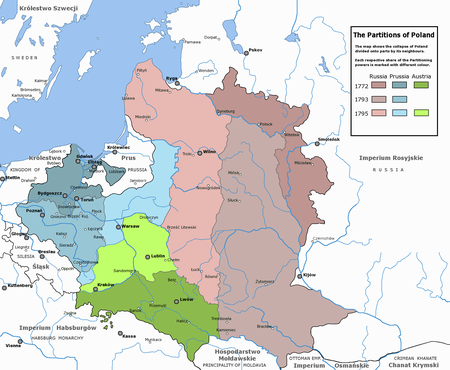
First partition divides Polish-Lithuanian Commonwealth between three neighboring countries in history.
Poland

Geopolitical Shifts
3 min read
Updated By: History Editorial Network (HEN)
Published:
The First Partition of Poland marked a significant turning point for the Polish-Lithuanian Commonwealth. It stemmed from the weakening central power, internal turmoil, and external pressure from neighboring empires. As a result, Russia, Prussia, and Austria seized the opportunity to expand their territories by dividing Poland among themselves. The three powers conspired in secret to carve up the Commonwealth, citing the need to restore order and stability.
The partition dealt a devastating blow to Poland, drastically reducing its land and population. The loss of key territories, including vital ports and resources, severely weakened Poland's economy and military power. The event highlighted Poland's vulnerability and sparked a series of subsequent partitions that ultimately wiped Poland off the map for over a century.
The impact of the First Partition extended beyond territorial loss. It highlighted the inefficiency of Poland's political system and the inability of its leaders to enact necessary reforms. The event served as a grim reminder of the dangers of internal division and external intervention.
The First Partition of Poland reshaped the geopolitical landscape of Eastern Europe, with lasting consequences for Poland and its people. The event symbolizes the struggle for independence, the dangers of external aggression, and the importance of unity in the face of adversity. #PolishLithuanianCommonwealth #GeopoliticalShifts #ForeignIntervention
Primary Reference
Partitions of Poland - Wikipedia

Explore the Life Moments of
 AI Twin