Establishment of the “Board of Peace”
World Economic Forum (WEF), Davos Congress Center, Davos, Switzerland
Political
10 min read
Updated By: History Editorial Network (HEN)
Published:
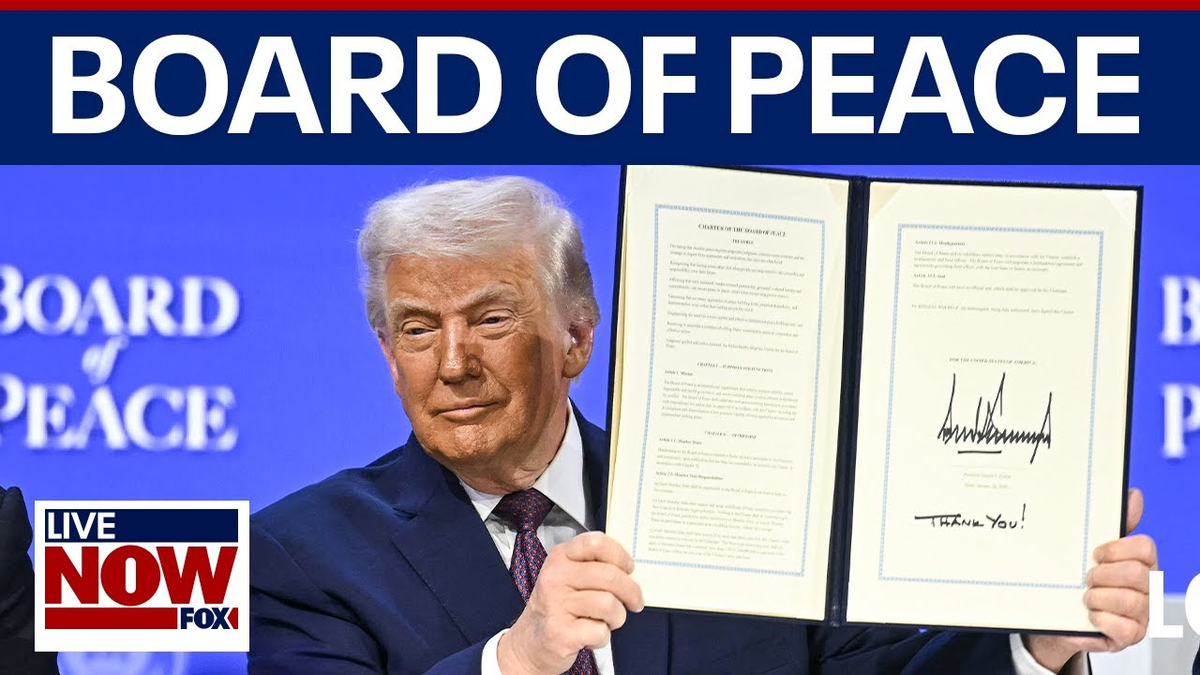
U.S. President Donald J. Trump presided over a public charter announcement and signing ceremony to launch an international body he called the Board of Peace, framed as a new mechanism to coordinate peace-building and post-conflict stabilization - initially tied to Gaza’s post-war governance and reconstruction, while also pitched as usable for other global conflicts.
At Davos, President Trump formally unveiled the Board of Peace and signed its charter during a WEF-side event. The launch included remarks by senior U.S. figures involved in the Gaza track, and the Board was presented as a high-level political platform that could expand beyond its original Gaza-centered concept.
• Why was it created (initial focus)?
The Board was introduced as part of Trump’s broader Gaza peace framework (often described as a “20-point” plan), with the UN later cited in reporting as having backed a U.S. plan for the Board to oversee Gaza governance and reconstruction under a renewable mandate. In parallel, Trump and allies described it as something that could also be used to broker or manage other conflicts worldwide, positioning it as a more “nimble” peace-building vehicle working “in conjunction” with the UN.
Leadership and key people involved:
• Chairman (inaugural): The charter explicitly names Donald J. Trump as the inaugural Chairman.
• Founding executive council (reported at launch): Trump was described as being supported by a top “founding executive council” including Marco Rubio (U.S. Secretary of State), Steve Witkoff (U.S. envoy), Jared Kushner, Tony Blair, Robert Gabriel (U.S. national security role cited in reporting), Ajay Banga (World Bank President), and Marc Rowan (Apollo Global Management CEO).
• Gaza-linked officials highlighted at/around launch: The event and related coverage referenced Nickolay Mladenov as High Representative for Gaza, and included a Gaza governance announcement by Ali Shaath, described as head of a future technocratic Palestinian government in Gaza.
• Countries joined: Argentina, Albania, Armenia, Azerbaijan, Bahrain, Belarus, Bulgaria, Egypt, Hungary, Indonesia, Israel, Jordan, Kazakhstan, Kosovo, Morocco, Mongolia, Pakistan, Qatar, Saudi Arabia, Turkey, United Arab Emirates, Uzbekistan, Vietnam.
• Norway, Sweden, Slovenia, France, and the UK confirmed they would not join, while a wider set of countries said they received invitations but had not clearly accepted at the time of reporting.
What the charter says?
• Mission (high level): The charter frames the Board as a peace-building body intended to “secure peace” where it has been elusive, emphasizing a departure from institutions and approaches described as having often failed.
• Membership model: Membership is limited to states invited by the Chairman.
• Each member state is represented by its Head of State or Government.
• Standard membership term is up to three years, renewable by the Chairman.
• The three-year term does not apply to member states that contribute more than USD $1,000,000,000 in cash within the first year after entry into force.
Decision-making and powers:
• Board decisions are by majority vote but require approval of the Chairman (who can also break ties).
• The Chairman has expansive authority, including exclusive authority to create/modify/dissolve subsidiary entities and a central role in interpreting the charter.
• An Executive Board exists; its decisions take effect immediately but are subject to veto by the Chairman.
• Legal status and operations: The charter states the Board and subsidiaries have international legal personality, can contract, hold property, open bank accounts, employ staff, and seek privileges/immunities via agreements with host states. Funding is described as voluntary from member states and other sources. The charter also allows for establishing a headquarters and field offices via host-state agreements, and sets English as the official language.
• Entry into force: The charter indicates it enters into force upon consent of three states, with provisions for provisional application and non-voting participation pending domestic ratification.
Notable announcements and immediate implications mentioned at launch:
• At the Davos event, Ali Shaath announced the Rafah crossing between Egypt and Gaza would open in both directions the following week (as reported). he Board’s Gaza vision was also described as aiming to shift Gaza away from long-term aid dependence using “free market principles,” with redevelopment concepts discussed publicly by Kushner.
#Peace

Explore the Life Moments of
 AI Twin