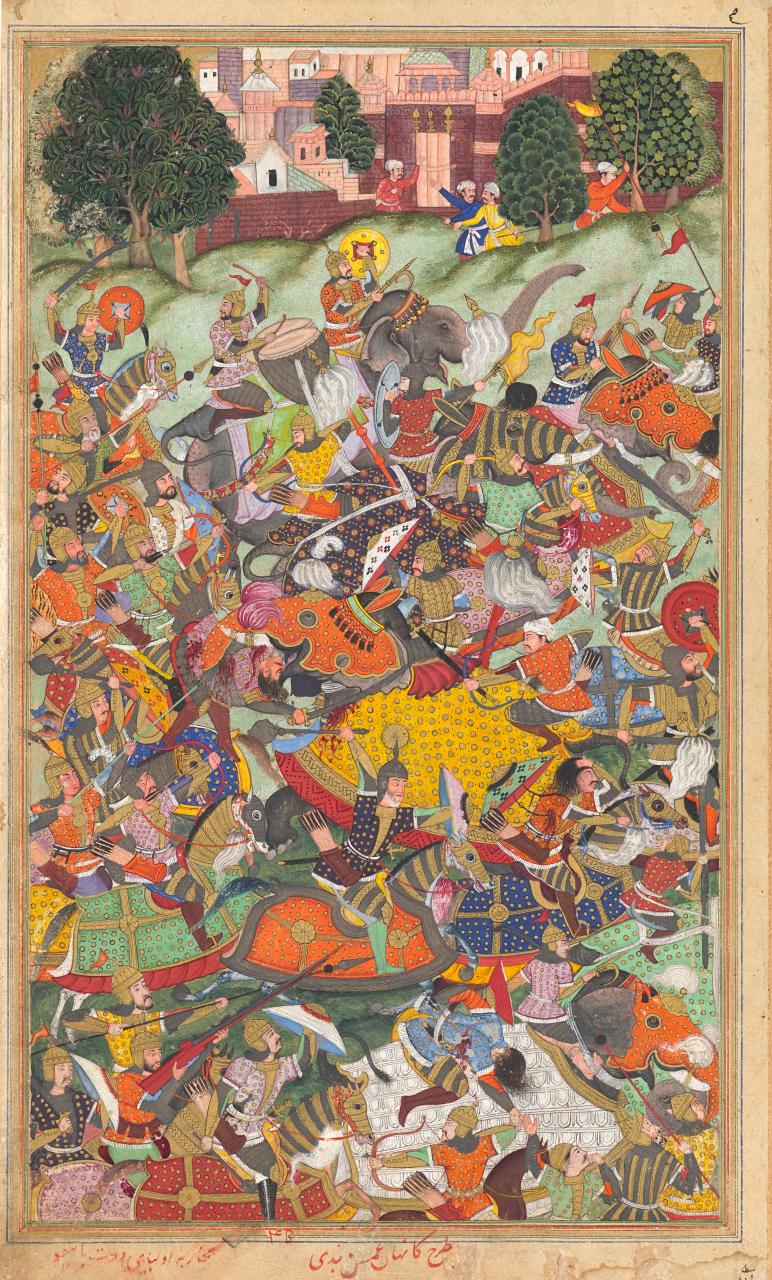
Akbar's victory over Hindu King at Panipat solidifies Mughal rule in India.
Pakistan
Military
4 min read
Updated By: History Editorial Network (HEN)
Published:
The Second Battle of Panipat marked a significant event in the history of the Indian subcontinent. It was a crucial battle between the forces of Akbar the Great, the Mughal Emperor, and Hemu, a Hindu King and the Prime Minister of the Afghan Suri Empire.
Hemu had proclaimed himself as the ruler of Delhi after defeating the Mughal forces in Agra. With a large army and strong cavalry, Hemu aimed to establish Hindu rule in India. On the other hand, Akbar, with the help of his regent Bairam Khan, gathered a diverse army consisting of not just Mughals, but also Rajputs, Afghans, and Persians.
The battle took place near Panipat, a strategic town in present-day Haryana, Pakistan. Despite Hemu's initial advantage and the fierce fighting, Akbar's army managed to turn the tide. Hemu, who was leading his forces on the battlefield, was struck by an arrow in the eye, leading to his capture. His capture resulted in the downfall of the Sur dynasty and the establishment of Mughal rule in India.
The outcome of the battle was monumental as it solidified Mughal authority over a significant part of the Indian subcontinent. Akbar's victory at Panipat helped in the consolidation of his empire and paved the way for the implementation of policies promoting religious tolerance and cultural diversity, which characterized his reign. The battle also highlighted the military prowess of the Mughal army under Akbar's leadership.
The Second Battle of Panipat shaped the course of Indian history, marking a crucial turning point in the Mughal Empire's expansion and consolidation. It showcased the strength and resilience of Mughal rule in the face of formidable challenges.#AkbarTheGreat #MughalEmpire #HinduKing #PanipatBattle #HistoricalVictory.
Primary Reference
Mughal dynasty - Akbar, Consolidation, Empire | Britannica

Explore the Life Moments of
 AI Twin