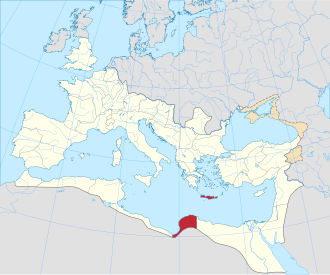
Roman Province Established in North Africa.
Libya
Global Trade
Economic Downturn
5 min read
Updated By: History Editorial Network (HEN)
Published:
The Roman province of Libya was officially established by incorporating parts of modern-day Libya into the existing Roman Empire. This administrative change followed a period of consolidation and expansion that saw Rome seeking to secure and manage its territories more effectively. Before becoming a province, the region was part of the Hellenistic Kingdom of Cyrenaica and had experienced varying degrees of influence from Greek and later Ptolemaic control.
The annexation was driven by Rome's strategic interests in securing its North African borders and exploiting the rich resources of the area, particularly with regard to agriculture and trade. The establishment of the province brought an organized system of governance and infrastructure development which included roads, public buildings, and fortifications. The region's cities, such as Cyrene, Apollonia, and Ptolemais, were integrated into the Roman administrative framework, leading to economic and cultural exchanges that enriched both Rome and the local populace.
The impact of this incorporation was multifaceted. Economically, it allowed Rome to control and benefit from the agricultural produce and natural resources such as silphium, a valuable plant. The establishment also entailed the stationing of Roman legions to safeguard the new province and maintain order. Socially, the local population experienced a significant degree of Romanization, seen in the adoption of Roman law, customs, and urban planning. However, this transition was not without resistance; there were occasional local revolts and social tensions as the indigenous populations adjusted to Roman rule.
Critical statistics from this period include the establishment of Roman colonies and the redistribution of land to Roman veterans, which helped in securing loyal settlers within the province. These colonies played crucial roles in the Roman military and agricultural strategies. The overall stability and prosperity brought by Roman administration contributed to Libya's integration into the broader imperial economy.
The Roman province of Libya thus marked a crucial juncture in North African history, characterized by administrative restructuring, economic integration, and cultural exchanges. The foundation laid by this establishment influenced the region's development for centuries to come and set the stage for its role within the Roman Empire.
#RomanEmpire #Libya #Province #AncientHistory #MoofLife
Primary Reference
Environmental Contamination from Uranium Production Facilities ...

Explore the Life Moments of
 AI Twin