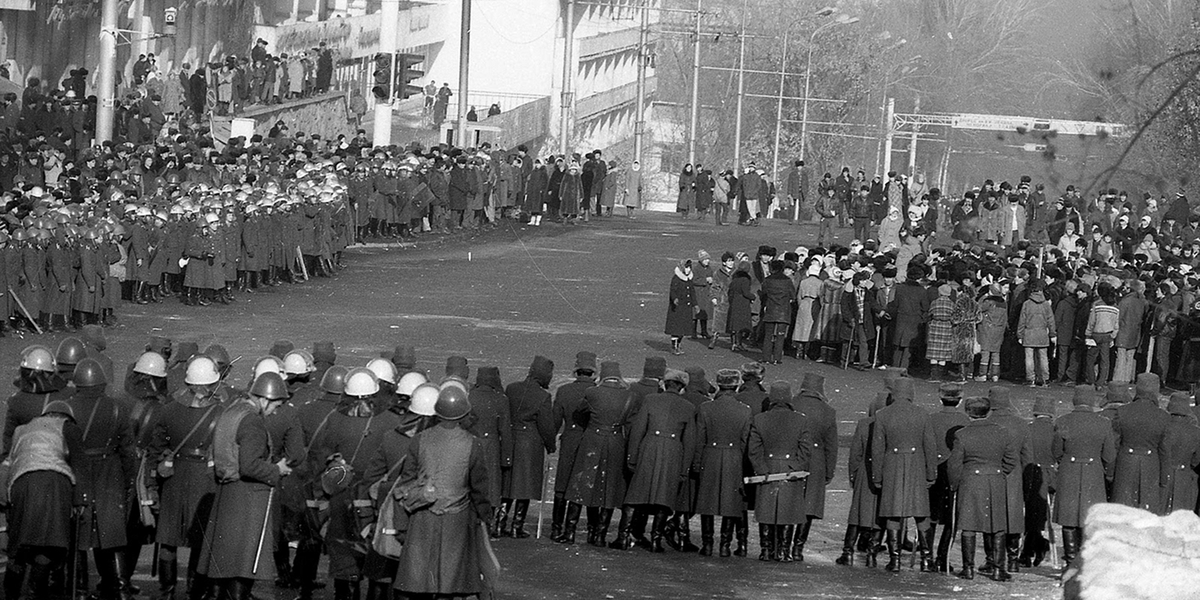
Jeltoqsan riot of 1986 sparked Kazakh dissent against soviet dominance
Brezhnev Square (today Republic Square), Alma-Ata/Almaty, in front of the Communist Party’s Central Committee building, Kazakhstan
Social Movements
Political
9 min read
Updated By: History Editorial Network (HEN)
Published:
Updated:
On 16 December 1986, the Jeltoqsan (Zheltoksan) protests were sparked in Alma-Ata (now Almaty), Kazakh SSR, after Moscow abruptly replaced Kazakhstan’s long-serving party leader Dinmukhamed Kunayev with Gennady Kolbin, a senior official seen locally as an outsider-igniting one of the earliest mass, openly defiant youth movements of the late Soviet era.
The background to Jeltoqsan lay in growing frustration-especially among Kazakh students and young workers-over how republic leadership was decided and how cultural and political power was concentrated under Soviet rule. When the leadership change was announced on 16 December, it quickly became a symbol of Moscow’s dominance: Kunayev, an ethnic Kazakh who had led the republic for many years, was removed and replaced by Kolbin, who had not built his career in Kazakhstan. To many, the appointment signaled that local voices and local legitimacy did not matter in the most senior decisions about the republic’s future.
What followed was a rapid escalation from political shock to street mobilization. Crowds of mostly young people-often described as students-began gathering in the city center, with the largest concentrations forming at Brezhnev Square/Republic Square. Demonstrations intensified into clashes as authorities moved to disperse people using police and internal-security forces, and the confrontation spread beyond the square into surrounding streets and areas tied to student life such as dormitories and campuses. While 16 December marks the catalytic leadership decision and the start of the “December events,” many accounts note that the largest street demonstrations surged the next morning and then continued for several days as the authorities pushed to regain control.
The crackdown produced a heavy human and institutional toll that remains sensitive in Kazakhstan’s historical memory. Reports consistently describe mass detentions and arrests, disciplinary actions against participants (including expulsions from universities and job repercussions), and injuries caused during dispersal operations. The number of deaths is disputed: Soviet-era reporting minimized fatalities, while later accounts and investigations have suggested higher totals and emphasize that the full scale was never transparently established. What is clear is that Jeltoqsan left deep scars, created long-lasting grievances about repression, and became a defining reference point for later debates about justice, historical truth, and national identity.
In the longer arc of Kazakhstan’s modern history, Jeltoqsan became widely seen as an early sign that the Soviet system’s authority was fracturing-years before the USSR formally dissolved. After independence, the events were increasingly commemorated as part of Kazakhstan’s national story, with Republic Square in Almaty remaining one of the most symbolically charged locations tied to the uprising and its memory.
In December 1986, the Jeltoqsan riot erupted in Almaty, Kazakhstan, marking a significant moment in the history of Soviet dissent. The protests were primarily led by young ethnic Kazakhs who were outraged by the appointment of Gennady Kolbin, a Russian from the Russian SFSR, as the First Secretary of the Communist Party of the Kazakh SSR, replacing the long-standing leader Dinmukhamed Konayev. This change was perceived as a disregard for the local population's interests and a continuation of Moscow's dominance over Kazakhstan. The demonstrations quickly escalated, with thousands of participants demanding political change and greater autonomy. In response, the Soviet government deployed troops to suppress the unrest, resulting in violent clashes that led to several fatalities and numerous arrests. The Jeltoqsan riot is often viewed as a precursor to the broader wave of nationalism and calls for independence that emerged in the late 1980s and early 1990s, particularly under Mikhail Gorbachev's policies of glasnost and perestroika, which encouraged openness and reform. This event remains a pivotal moment in Kazakhstan's struggle for identity and sovereignty, symbolizing the growing discontent with Soviet rule and the desire for self-determination among the Kazakh people.
#JeltoqsanRiot #KazakhstanHistory #SovietUnion #EthnicKazakhs #MikhailGorbachev
#Jeltoqsan
Primary Reference
JELTOQSAN - The Chronology of December 1986

Explore the Life Moments of
 AI Twin