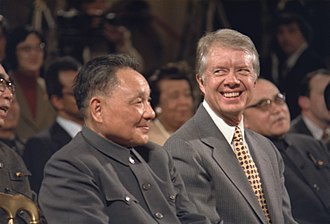
US Establishes Full Diplomatic Relations with China
Global Politics
International Trade
6 min read
Updated By: History Editorial Network (HEN)
Published:
The establishment of full diplomatic relations between the United States and China marked a pivotal change in global dynamics. This shift followed two decades of estrangement following the Chinese Revolution and the subsequent establishment of the People's Republic of China. The event was facilitated by U.S. President Jimmy Carter, who sought to formally recognize the Communist government in Beijing as the legitimate government of China, instead of the Nationalist government based in Taiwan.
Previously, the U.S. had only maintained informal relations with China despite the clandestine diplomacy initiated by Henry Kissinger and President Richard Nixon earlier. Nixon’s visit to China, including his meeting with Chairman Mao Zedong, laid the groundwork for this development. The normalization of relations involved several key agreements, including assurances on the Taiwan issue; the U.S. would acknowledge Beijing's position on Taiwan while continuing to support peaceful resolution across the Taiwan Strait.
Trade between the two nations had been minimal, but the normalization allowed economic exchanges to flourish. The U.S. looked towards China both as a counterbalance to Soviet influence in Asia and as a burgeoning market for American goods. This new policy promised diverse economic prospects, although it also involved strategic and ideological recalibrations, considering China's role in the global communist movement.
The impact of this diplomatic breakthrough was multifaceted: it led to an increase in bilateral trade, significant cultural exchanges, and greater mutual understanding between the two nations. Bilateral trade, which started modestly, saw exponential growth in the following decades. For instance, U.S. exports to China increased more than tenfold within twenty years, significantly impacting various sectors.
This shift didn't come without controversy. Many in the U.S. Congress and among Taiwan’s allies raised concerns about the implications for Taiwan’s security and U.S. commitments under the Taiwan Relations Act. However, the U.S. refrained from taking a definitive stance on Taiwan’s status, instead advocating for a peaceful resolution to the cross-strait issues.
The establishment of diplomatic relations between the United States and China set the stage for a dynamic and often complex relationship that has had profound implications for international politics, economics, and security.
#USChinaRelations #Diplomacy #JimmyCarter #TaiwanPolicy #GlobalPolitics #PeacefulResolution #Geopolitics #EconomicGrowth #InternationalTrade #MoofLife
Primary Reference
Milestones in the History of U.S. Foreign Relations
Explore the Life Moments of
 AI Twin