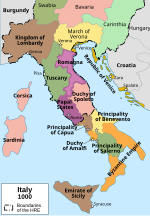
Lombard kings: Arioald's succession after Agilulf.
Italy
Political
3 min read
Updated By: History Editorial Network (HEN)
Published:
In 626, the Lombard king Arioald succeeded Agilulf in Italy. Arioald's ascension to the throne marked a significant shift in leadership within the Lombard kingdom. Agilulf, who had ruled for over two decades, had been known for his military prowess and consolidation of power. Arioald's reign was characterized by efforts to maintain the stability and expansion of the Lombard kingdom. He faced challenges from within his own court as well as external threats from neighboring powers. Arioald continued his predecessor's policies of alliances with other kingdoms while also asserting his authority over regions that had shown signs of rebellion. During Arioald's rule, there were significant social and political developments within the Lombard kingdom. He implemented reforms aimed at strengthening the economy and centralizing power. Arioald also sought to improve relations with the Roman population, which had been under Lombard control for several decades. The succession of Arioald to the throne had implications for the broader political landscape of Italy. It signaled a continuation of Lombard dominance in the region and set the stage for future conflicts and alliances with other powers, including the Byzantine Empire. Overall, Arioald's reign as Lombard king was a period of consolidation and change within the Lombard kingdom. His policies and decisions during this time would shape the political and social dynamics of Italy for years to come. #LombardKingdom #Italy #ArioaldSuccession
Primary Reference
Arioald - Wikipedia

Explore the Life Moments of
 AI Twin