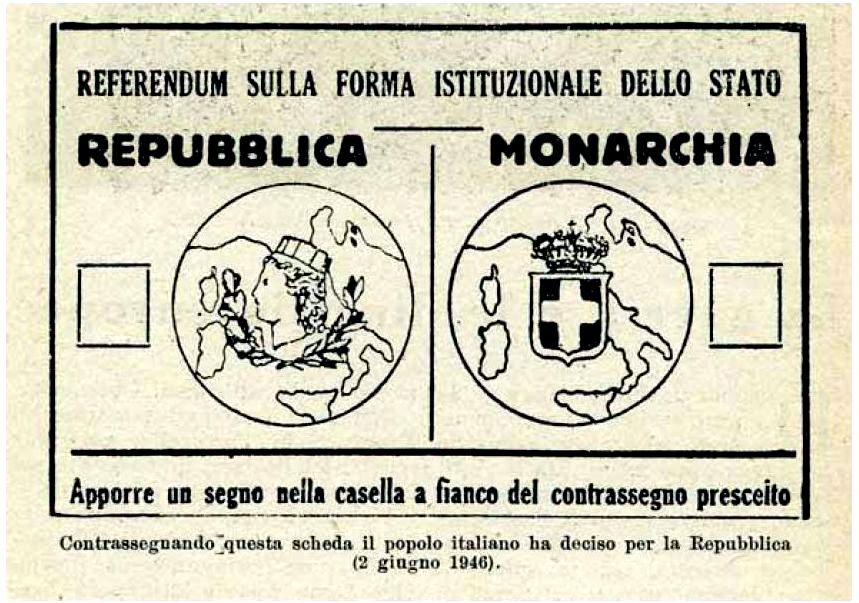
Formation of the Italian Republic after a constitutional referendum.
Italy

Political
9 min read
Updated By: History Editorial Network (HEN)
Published:
The formation of the Italian Republic is a defining moment in Italy's history, marked by the constitutional referendum held on June 2, 1946. This pivotal event followed the turmoil of World War II and the fall of Benito Mussolini's Fascist regime, setting the stage for a profound transformation in Italy's political landscape.
Background
Italy had been a monarchy under the House of Savoy since its unification in 1861. However, the monarchy's association with Fascism, particularly under King Victor Emmanuel III, who had supported Mussolini, significantly tarnished its image. Following Mussolini's ousting in 1943 and Italy's subsequent armistice with the Allies, the country was left divided and in search of a new direction. The end of the war brought a desire for change and the reconstruction of a war-torn nation.
The Referendum
On June 2, 1946, Italians were called to vote in a referendum to decide whether to retain the monarchy or establish a republic. This referendum was historic not only for its outcome but also because it was the first time Italian women were allowed to vote in a national election, marking a significant step towards gender equality in Italy.
The voter turnout was exceptionally high, reflecting the intense public interest in the future governance of the country. The results were decisive: approximately 54.3% voted in favor of abolishing the monarchy and establishing a republic. The geographical distribution of the vote highlighted a clear divide: the northern and central regions, which had been strongholds of the anti-fascist resistance, overwhelmingly supported the republic, while the southern regions were more inclined to retain the monarchy.
King Umberto II and Exile
In an attempt to salvage the monarchy's future, King Victor Emmanuel III had abdicated on May 9, 1946, in favor of his son, Umberto II. However, despite Umberto II's efforts during his brief reign, the referendum result was unequivocal. Following the vote, Umberto II was required to leave Italy. On June 13, 1946, he went into exile in Portugal, where he lived until his death in 1983. His departure symbolized the end of the Savoy dynasty's rule over Italy.
Establishment of the Republic
With the monarchy abolished, Italy officially became a republic. On June 18, 1946, Enrico De Nicola was appointed as the provisional Head of State. The same year, a Constituent Assembly was elected to draft a new constitution for the republic. This assembly, composed of representatives from various political parties, worked diligently to create a framework that would ensure democratic governance and protect civil liberties.
The new Italian Constitution was promulgated on January 1, 1948. It established a parliamentary republic, characterized by a separation of powers among the executive, legislative, and judicial branches of government. The constitution also enshrined fundamental rights and freedoms, marking a clear break from the authoritarianism of the past.
Significance
The formation of the Italian Republic marked a new beginning for Italy. It was a decisive move away from the monarchy and the fascist dictatorship that had brought the country to the brink of destruction. The transition to a republic laid the foundation for Italy's post-war recovery and development into a modern democratic state.
This period also saw significant social and political changes. The inclusion of women in the electoral process was a major step forward in gender equality. The establishment of democratic institutions and the protection of civil liberties provided a stable environment for economic growth and social progress.
The new republic faced numerous challenges, including political instability and economic reconstruction. However, the democratic principles enshrined in the constitution guided Italy through these difficulties, eventually leading to prosperity and a prominent role in the international community, particularly as a founding member of the European Economic Community.
#ItalianRepublic #ConstitutionalReferendum #EndOfMonarchy #1946Italy #DemocraticItaly #MomentsOfLife #MoofLife_Moment #MoofLife
Primary Reference
1946 Italian institutional referendum - Wikipedia

Explore the Life Moments of
 AI Twin