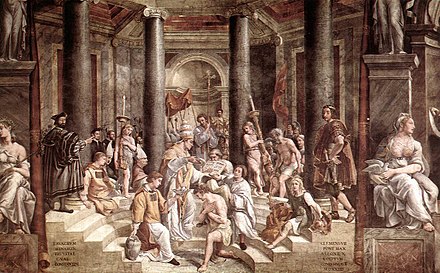
Constantine the Great adopts Christianity, significantly impacting Roman Empire's religious landscape and trajectory.
Italy
3 min read
Updated By: History Editorial Network (HEN)
Published:
In 312, a defining moment in both religious and world history occurred when Constantine the Great, the Roman Emperor, converted to Christianity. This transformation is intimately tied to the Battle of the Milvian Bridge, where Constantine faced off against Maxentius for control of the Western Roman Empire. According to historical accounts, the night before the battle, Constantine experienced a profound religious vision. He saw the Christian Chi-Rho symbol in the sky accompanied by the words "In hoc signo vinces" ("In this sign, you will conquer"). Inspired by this vision, Constantine had his soldiers mark their shields with the symbol. The subsequent victory at the Milvian Bridge was not just a military triumph but also a pivotal religious turning point. Constantine's conversion signified the end of centuries of pagan dominance in the Roman Empire and the beginning of an era where Christianity would rise to prominence. It eventually led to the Edict of Milan in 313, granting religious tolerance throughout the empire. Constantine's conversion had profound implications, shaping the religious, cultural, and political landscape of Europe for centuries to come.
#ConstantineTheGreat #Christianity #RomanEmpire #BattleOfMilvianBridge #ReligiousHistory
Primary Reference
www.quondam.com/03/0312.htm

Explore the Life Moments of
 AI Twin