The British Invasion of Java
Indonesia

Colonial Expansion
Trade Routes
7 min read
Updated By: History Editorial Network (HEN)
Published:
In 1811, the British East India Company, under the command of Lord Minto, the Governor-General of India, decided to launch an expedition to seize Java from the Dutch-French control. The operation was meticulously planned, and the British assembled a significant military force, which included British troops, Indian sepoys, and naval support.
The British expeditionary force, commanded by Lieutenant-General Sir Samuel Auchmuty, arrived off the coast of Java in August 1811. They targeted Batavia (modern-day Jakarta), the capital and administrative center of the Dutch East Indies.
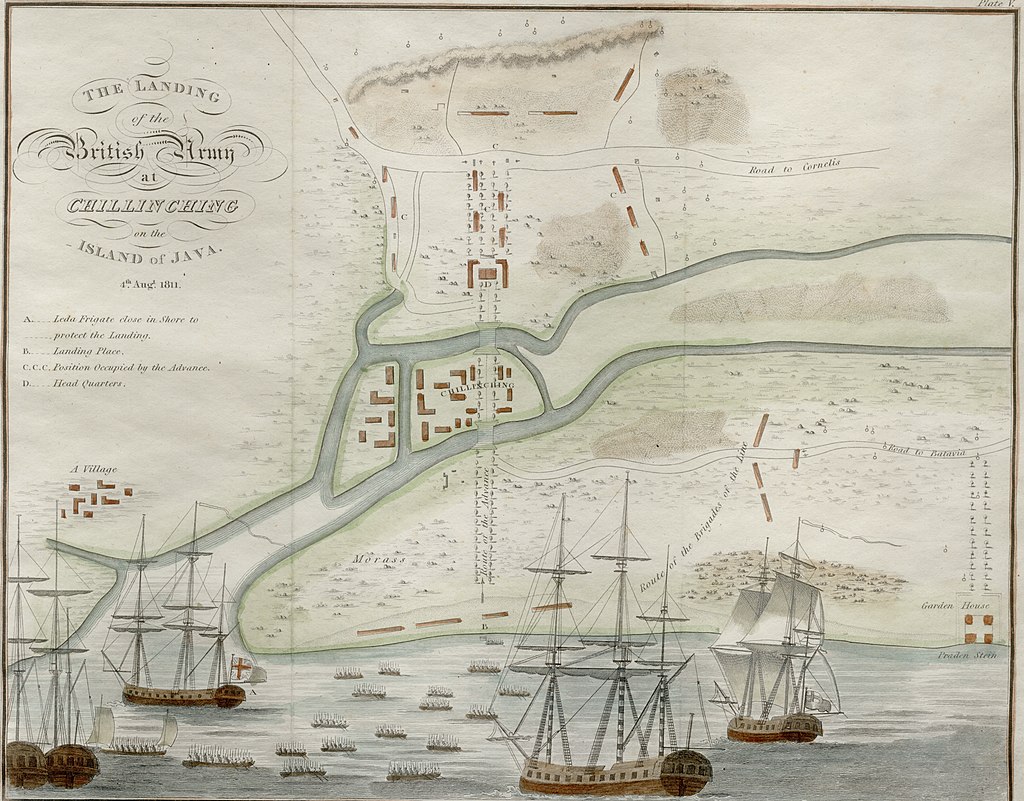
After landing near Batavia on August 4, 1811, the British forces swiftly advanced towards the city. The Dutch, under the leadership of Governor-General Herman Willem Daendels, had been preparing for such an attack, but by the time of the invasion, Daendels had been replaced by Janssens, who was less capable. The Dutch defenses were overwhelmed by the better-organized and more powerful British forces. Batavia fell to the British on August 8, 1811, after only a brief resistance.
Following the fall of Batavia, the British pursued the remaining Dutch forces, leading to the decisive Battle of Meester Cornelis (now Jatinegara) on August 26. The battle was a significant defeat for the Dutch, and after suffering heavy losses, the remaining Dutch forces retreated inland. On September 18, 1811, Governor-General Janssens surrendered near Semarang, effectively ending Dutch resistance on the island.
British Administration in Java
The British established a new administration in Java, led by Thomas Stamford Raffles, who was appointed as the Lieutenant-Governor. Raffles, an ambitious and reform-minded administrator, implemented several changes in Java during the brief British rule (1811-1816).
Raffles sought to modernize the colonial administration and reduce the influence of the existing Dutch elites. He introduced reforms aimed at improving the efficiency of the government and the economic exploitation of the colony. These included changes in land tenure and tax collection systems, with an emphasis on direct taxation rather than the previous Dutch system, which relied on local intermediaries.
One of Raffles' most significant contributions was his emphasis on the study and preservation of Javanese culture. He was a keen scholar of the region’s history and geography, and his work during this period laid the foundation for future studies of Javanese culture and history. Raffles also played a role in the preservation of the Borobudur temple, which had fallen into disrepair.
The Return of Java to the Dutch
Despite these reforms, British rule in Java was short-lived. The Napoleonic Wars in Europe concluded with Napoleon's defeat in 1815, leading to the Congress of Vienna, where the major European powers redrew the map of Europe and restored many pre-war boundaries. As part of the post-war settlements, Java was returned to Dutch control in 1816.
The brief British interlude left a lasting impact on Java, particularly through Raffles' reforms and scholarly contributions. However, the island once again became part of the Dutch colonial empire, remaining under Dutch control until Indonesia's independence in the mid-20th century.
#MomentsOfLife #MoofLife_Moment #MoofLife #Java1811 #BritishInvasion #ColonialHistory
Primary Reference
Invasion of Java (1811) - Wikipedia

Explore the Life Moments of
 AI Twin