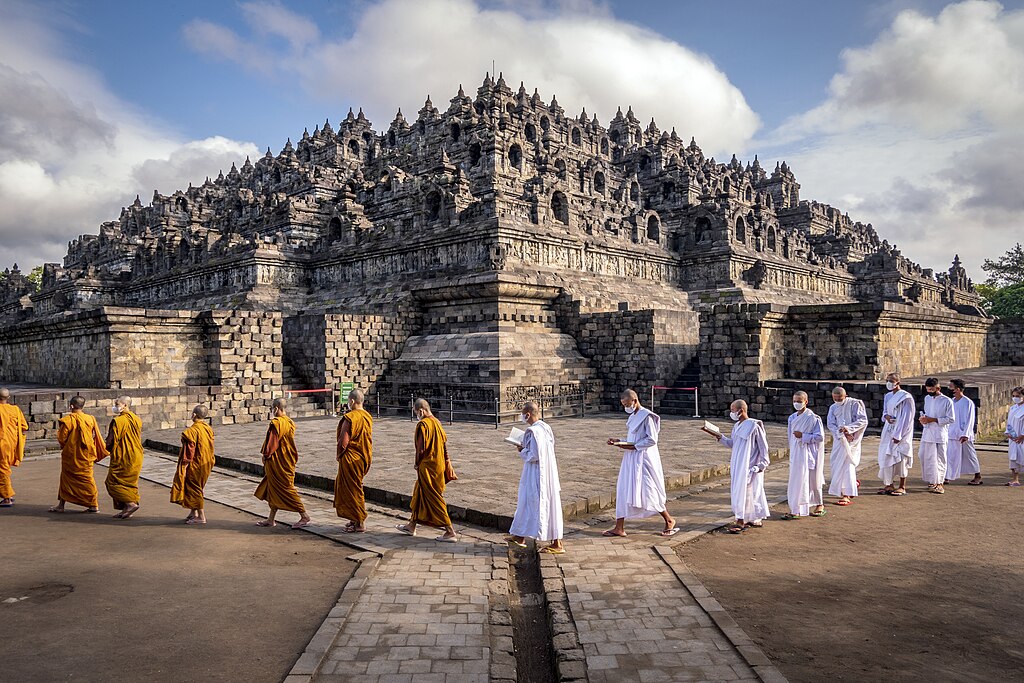
Borobudur: Ancient Construction of Buddhist Temple
Indonesia

Cultural Heritage
5 min read
Updated By: History Editorial Network (HEN)
Published:
Borobudur, a massive Mahayana Buddhist temple, stands as a remarkable achievement in ancient architecture. Constructed during the rule of the Sailendra Dynasty in central Java, Indonesia, it exemplifies the intricate art and deep religious devotion of the period. The temple is strategically situated on a high hill between two twin volcanoes, the Merbabu and Merapi, and two rivers, the Progo and the Elo.
The project was commissioned by a king of the Sailendra Dynasty, embedding the structure with both political and spiritual significance. The design incorporates influences from Gupta art, which reflects India's profound impact on the Southeast Asian region at the time. Borobudur consists of nine stacked platforms, six square and three circular, topped by a central dome. The structure features over 2,500 relief panels and 504 Buddha statues, representing the Javanese interpretation of Buddhist cosmology.
Built without cement or mortar, the labor-intensive construction utilized intricately carved interlocking volcanic stone blocks. The central dome is surrounded by 72 Buddha statues, each seated inside a perforated stupa. This architectural wonder stands as a testament to the artistic precision and engineering expertise of its creators.
The significance of Borobudur extends beyond its architectural marvel. It serves as an important pilgrimage site for Buddhists, who walk through its corridors and ascend its platforms in a symbolic journey towards enlightenment. Scholars believe that the monument was designed to reflect the Buddhist concept of attaining nirvana, with its three main levels symbolizing the earthly realm, the transitional sphere, and the ultimate sphere of enlightenment.
Borobudur's legacy is preserved not only in its physical structure but also in its role as a cultural and religious icon. Its construction signifies the spread of Buddhism in Java, and it remains an enduring testimony to the blending of cultural, religious, and political influences in the region.
The impact of Borobudur on Indonesia’s cultural heritage is profound. It remains a focal point of national pride and identity. Each year, it attracts thousands of visitors from around the globe, making it one of Indonesia’s most visited tourist attractions and an important site of historical study.
#Borobudur #CulturalHeritage #BuddhistArchitecture #AncientEngineering #IndonesiaHistory #MoofLife
Primary Reference
Indonesia- Part 1: Yogyakarta, Borobudur & Prambanan | Backpack ...

Explore the Life Moments of
 AI Twin