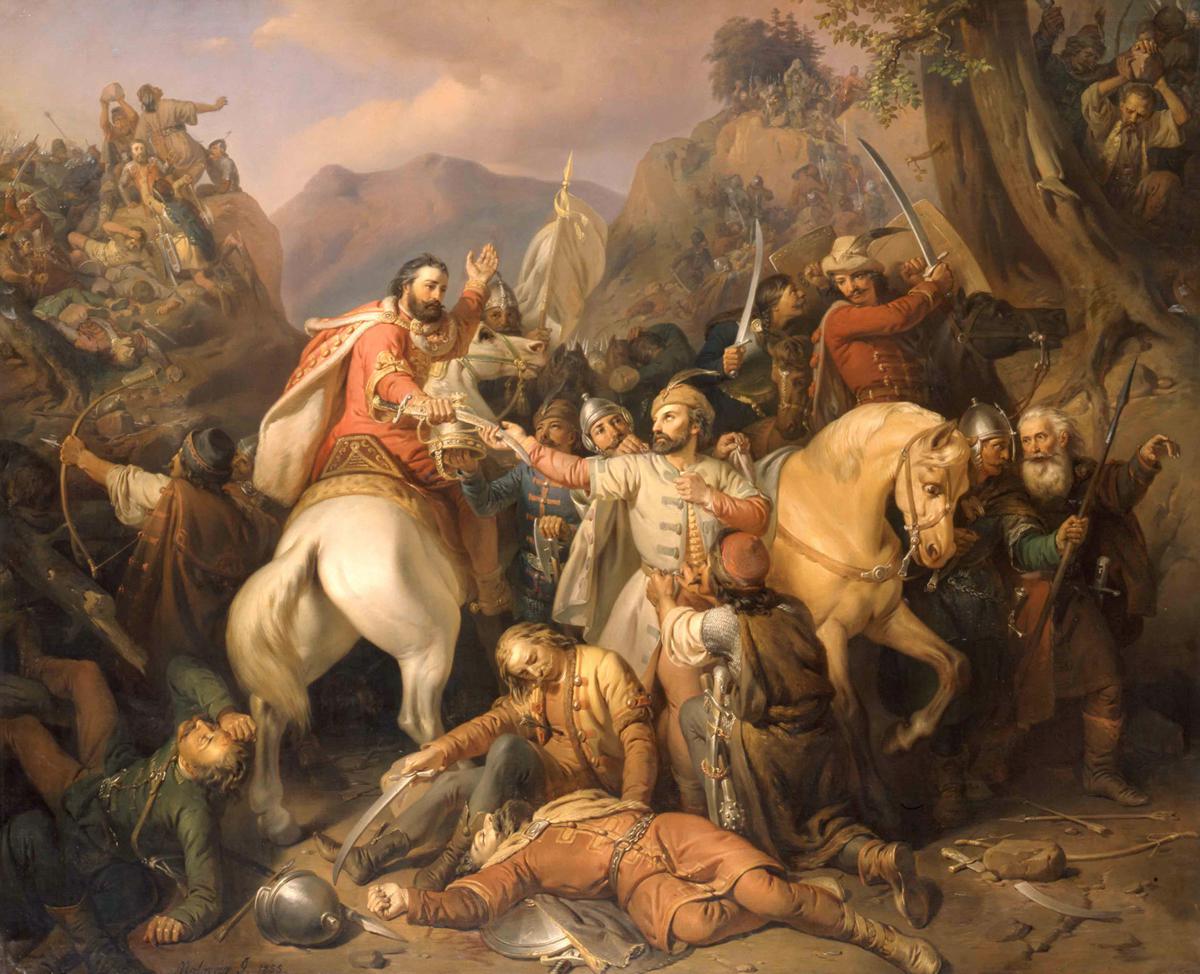
The Battle of Posada: Basarab I defeats Hungarian army in ambush.
Hungary
Political
Military
5 min read
Updated By: History Editorial Network (HEN)
Published:
In the early 14th century, the political landscape of Central and Eastern Europe was a complex web of conflicts and alliances. The Kingdom of Hungary, under the rule of King Charles Robert, aimed to assert dominance over the various voivodeships and principalities in the Carpathian Basin, including Wallachia. Voievode Basarab I, the ruler of Wallachia, sought to maintain his territory's sovereignty amidst Hungary's expansionist ambitions.
The tension culminated when King Charles Robert led his army into Wallachian territory, seeking to subjugate Basarab I. Anticipating the Hungarian invasion, Basarab I devised a strategic defense plan that capitalized on his knowledge of the local terrain. The Wallachian voievode orchestrated an ambush in a narrow mountain pass known today as Posada.
As the Hungarian forces advanced, their progress was hindered by the challenging terrain and dense forests. Basarab I and his troops lay in wait in concealed positions along the steep slopes. When the Hungarian army reached the pass, the Wallachians launched a sudden and coordinated attack from multiple directions. The element of surprise, combined with the difficult environment, rendered the heavily armed Hungarian knights and soldiers vulnerable.
The Wallachian forces employed guerrilla tactics, utilizing the natural advantages of the terrain to inflict significant casualties on the Hungarian army. The chaotic and constrained conditions prevented the Hungarians from organizing an effective counterattack. Over several days, the ambush forced the Hungarian forces into a retreat, marking a decisive victory for Basarab I and ensuring Wallachia's autonomy from Hungarian dominance.
This ambush demonstrated the effectiveness of unconventional warfare against a superior military force and highlighted the strategic acumen of Basarab I. The outcome reshaped the regional power dynamics, reinforcing Wallachia's independence and altering Hungarian military strategies in future conflicts.
The Battle of Posada had a lasting impact on the region's history, symbolizing the resilience of smaller states against larger, more powerful adversaries. It also underscored the importance of terrain and local knowledge in warfare, influencing military tactics in subsequent centuries.
#BasarabI #WallachianAmbush #HungarianArmy #MedievalWarfare #StrategicVictory #WallachianIndependence #MoofLife

Explore the Life Moments of
 AI Twin