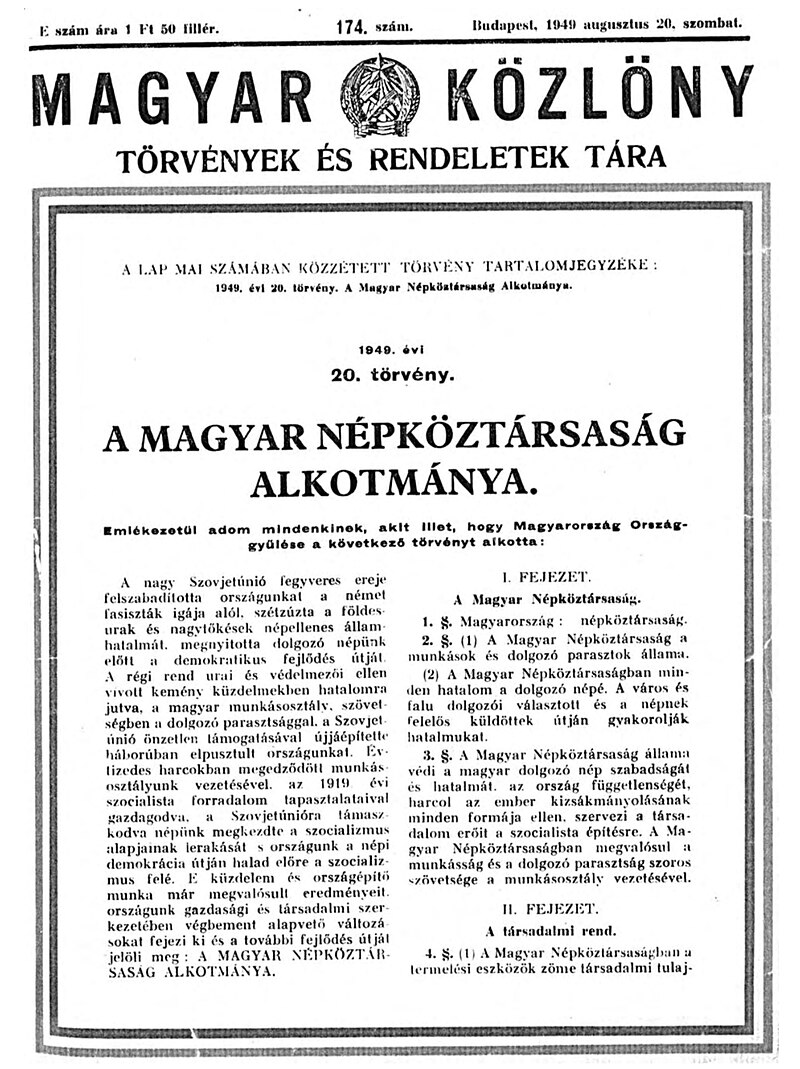
New Constitution Reflects Socialist Principles
Hungary
Political
Socialism
5 min read
Updated By: History Editorial Network (HEN)
Published:
Following the close of World War II, Hungary found itself under the influence of the Soviet Union, which gradually imposed its political and social framework on the nation. As the Hungarian Workers' Party consolidated power, efforts to reshape the nation’s governmental structure and bylaws began to crystallize. The new Hungarian Constitution was adopted, fundamentally transforming the country's legal and political landscape.
The freshly established constitution drew heavily from the Stalinist model, incorporating socialist principles that emphasized the role of the working class and the state's control over resources. Private property was largely abolished, replaced by state ownership and collective farming initiatives. Instituting a single-party system, the constitution outlined the structure and functions of the government, which included a governing role for the Hungarian Workers' Party, sidelining any multiparty democracy.
This shift ushered in comprehensive changes, particularly in economic policies and social services. The nationalization of industries aimed to push economic self-sufficiency, aligning the country with broader Soviet policies. Education and healthcare systems were extensively overhauled to reflect socialist ideologies, increasing accessibility but often emphasizing ideological compliance and loyalty to the state.
The impact on civil liberties was profound. Freedom of speech, press, and association were severely restricted. The state exerted extensive control over media and educational content, promoting propaganda that aligned with socialist values. Surveillance and persecutions became common against dissenters and political opponents.
Population records from that period indicate a rural-to-urban migration, driven by the state’s focus on industrialization. While these policies aimed to create an egalitarian society, they often resulted in economic hardship, inefficiency, and reduced agricultural output, causing food shortages and lowering the standard of living for many Hungarians.
Despite these challenges, the adoption of the new constitution solidified the alignment of Hungary with the Eastern Bloc, creating a socialist state underpinned by significant Soviet influence. This period set the stage for subsequent political, social, and economic developments, rippling through the ensuing decades.
#Hungary #Constitution #Socialism #EasternBloc #PoliticalChange #StateControl #WorkersParty #1940s #MoofLife
Primary Reference
OPINION ON THE NEW CONSTITUTION OF HUNGARY Adopted by ...

Explore the Life Moments of
 AI Twin