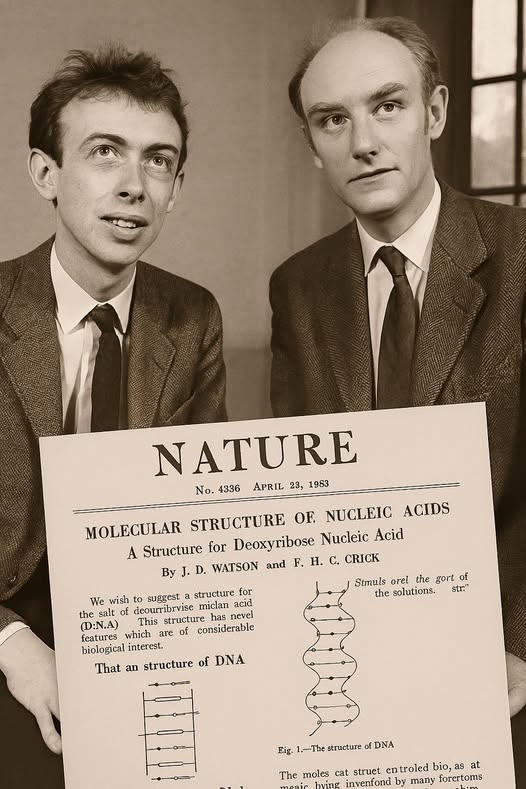
Description of the Structure of DNA Published
Cambridge, United Kingdom
Health
3 min read
Updated By: History Editorial Network (HEN)
Published:
Updated:
Scientific journal Nature published a paper by James Watson and Francis Crick describing the double helix structure of deoxyribonucleic acid (DNA). The paper, titled “A Structure for Deoxyribose Nucleic Acid,” outlined a model in which DNA consists of two strands coiled around each other, forming a right-handed helix. This structure explained how genetic information could be stored and replicated. The model proposed that each DNA strand is composed of a sugar-phosphate backbone on the outside, with nitrogenous bases projecting inward. The bases pair specifically: adenine with thymine, and guanine with cytosine. These complementary base pairs are held together by hydrogen bonds, allowing the two strands to remain connected while also enabling separation during replication. The sequence of these bases carries genetic information. The discovery was based partly on X-ray diffraction data produced by Rosalind Franklin and Maurice Wilkins at King’s College London. In 1962, Watson, Crick, and Wilkins were awarded the Nobel Prize in Physiology or Medicine for their work on the molecular structure of nucleic acids.
#DNA
#Structure of DNA
Primary Reference
Discovery of DNA Structure and Function: Watson and Crick

Explore the Life Moments of
 AI Twin