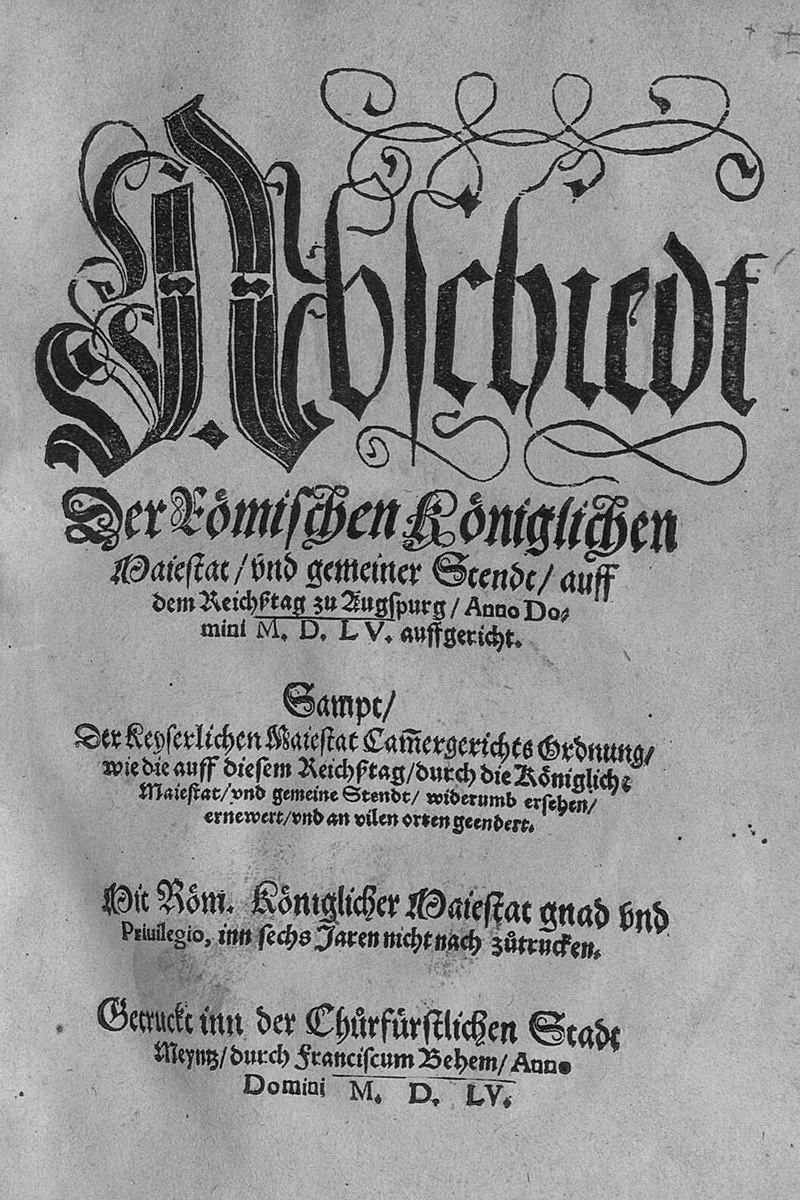
The Peace of Augsburg is signed, establishing religious tolerance between Catholicism and Lutheranism
Germany

8 min read
Updated By: History Editorial Network (HEN)
Published:
On September 25, 1555, the Peace of Augsburg was signed in the Holy Roman Empire, marking a pivotal moment in European history by establishing legal religious tolerance between Catholicism and Lutheranism. This treaty was a significant milestone in the quest for religious coexistence, emerging from the Reformation’s tumultuous backdrop and fundamentally shaping the political and religious landscape of Germany.
Background
The Protestant Reformation, initiated by Martin Luther in 1517, had drastically altered the religious fabric of Europe. Luther's criticisms of the Catholic Church's practices, encapsulated in his Ninety-Five Theses, sparked widespread theological debate and led to the formation of Lutheranism. The Reformation's spread resulted in significant political and religious fragmentation within the Holy Roman Empire, a complex mosaic of semi-autonomous territories under the nominal authority of the Emperor.
The Holy Roman Emperor, Charles V, a staunch Catholic, sought to suppress the growing Protestant movement. However, the Protestant Reformation continued to gain traction, leading to a series of conflicts, notably the Schmalkaldic War (1546–1547), between Catholic forces and the Protestant Schmalkaldic League. Despite Charles V's initial military successes, he was unable to achieve a decisive victory that would restore Catholic unity in the empire.
The Diet of Augsburg
The Peace of Augsburg was negotiated during the Diet of Augsburg, a formal assembly of the empire's princes and other key stakeholders. The treaty was an attempt to bring an end to the ongoing religious conflicts and to establish a framework for religious coexistence. Key figures in the negotiation included Charles V's brother, Ferdinand I, who played a crucial role in brokering the agreement, as Charles V was increasingly occupied with other matters and later abdicated in 1556.
Key Provisions
The Peace of Augsburg contained several critical provisions:
Cuius Regio, Eius Religio: This principle, translating to "Whose realm, his religion," granted each ruler within the Holy Roman Empire the authority to determine the official religion of their own state. This meant that subjects were expected to follow the religion chosen by their ruler, be it Catholicism or Lutheranism.
Religious Tolerance: The treaty formally recognized Lutheranism as a legitimate religion alongside Catholicism. This legal recognition was significant as it provided a measure of religious freedom to Lutherans within the empire.
Ecclesiastical Reservation: This clause stipulated that if a prince-bishop or other ecclesiastical ruler converted to Lutheranism, they would forfeit their ecclesiastical territories. This was intended to prevent the secularization of church lands and maintain the Catholic Church’s territorial integrity.
Impact and Legacy
The Peace of Augsburg had profound and lasting impacts:
Temporary Stability: The treaty brought a temporary cessation of religious wars within the Holy Roman Empire and provided a legal framework for religious coexistence. This allowed for a period of relative peace and stability.
Limited Scope: The peace only applied to Lutheranism and Catholicism, excluding other emerging Protestant movements such as Calvinism and Anabaptism, which continued to face persecution. This limitation would later contribute to further religious conflicts.
Foundation for Future Agreements: The principles established in the Peace of Augsburg set a precedent for future efforts to negotiate religious tolerance, notably influencing the later Peace of Westphalia in 1648, which ended the Thirty Years' War and expanded religious tolerance to include Calvinism.
#MomentsOfLife #MoofLife_Moment #MoofLife #PeaceOfAugsburg #ReligiousTolerance #Reformation #HolyRomanEmpire #EuropeanHistory #CuiusRegioEiusReligio
Primary Reference
Peace of Augsburg - Wikipedia

Explore the Life Moments of
 AI Twin