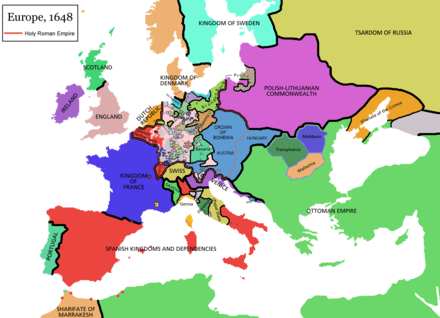
Peace treaty ends Thirty Years' War, establishes state sovereignty principles in Westphalia.
Germany

Political
3 min read
Updated By: History Editorial Network (HEN)
Published:
The Peace of Westphalia marked the conclusion of the Thirty Years' War in Germany, a conflict driven by religious and territorial disputes. This event established the core principles of state sovereignty, granting autonomy to individual states and allowing for religious freedom and diversity within the region. The treaty consisted of two separate agreements, the Treaty of Osnabrück and the Treaty of Münster, collectively bringing peace to the war-torn lands.
The Peace of Westphalia had a profound impact on the political landscape of Europe, shifting the power dynamics from absolute monarchies to a system of sovereign states. It also set a precedent for future international agreements by emphasizing the importance of diplomacy and negotiation in resolving conflicts. The treaty's recognition of the sovereignty of individual states laid the foundation for the modern system of nation-states, shaping the course of European history for centuries to come.
This historic event at Westphalia not only brought an end to a devastating war but also paved the way for a new era of diplomacy and statecraft. It highlighted the importance of respecting the autonomy and independence of nations, ultimately contributing to the stability and balance of power in Europe.
#WestphaliaPeace #SovereigntyPrinciples #ThirtyYearsWar #Diplomacy #StateAutonomy

Explore the Life Moments of
 AI Twin