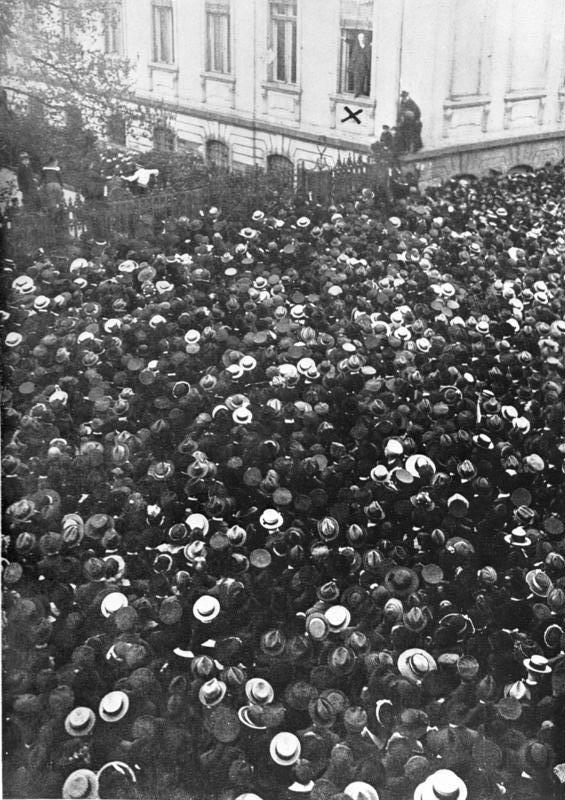
Establishing the Weimar Republic after Kaiser Wilhelm II's abdication amid political unrest.
Germany
Political
Military Conflict
3 min read
Updated By: History Editorial Network (HEN)
Published:
Updated:
Following the abdication of Kaiser Wilhelm II, Germany saw the birth of the Weimar Republic. This marked a significant shift in governance, transitioning from a monarchy to a democratic system. The Treaty of Versailles, signed at the end of World War I, had weakened the German Empire, leading to political instability and economic crises.
The Weimar Republic faced numerous challenges, including hyperinflation, political extremism, and social unrest. Despite efforts to stabilize the country, the Republic struggled to gain widespread support. The German population was disillusioned with the government, leading to a rise in far-right and far-left movements.
The impact of the Weimar Republic was profound. It laid the foundation for democratic governance in Germany but ultimately failed to establish a stable political system. The shortcomings of the Republic paved the way for the rise of the Nazi Party and the eventual establishment of a totalitarian regime under Adolf Hitler.
The formation of the Weimar Republic after the abdication of Kaiser Wilhelm II represents a pivotal moment in German history, highlighting the challenges of transitioning from autocracy to democracy. #WeimarRepublic #Germany #KaiserWilhelmII #PoliticalTransition #Democracy
Primary Reference
The Kaiser abdicates – The Holocaust Explained: Designed for ...

Explore the Life Moments of
 AI Twin