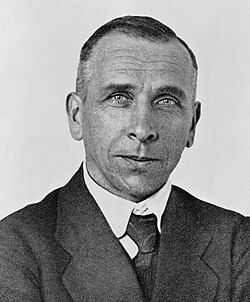
Alfred Wegener publicly presents the continental drift hypothesis in Frankfurt
Senckenberg Museum, Frankfurt am Main, Germany
Technology
Science
3 min read
Updated By: History Editorial Network (HEN)
Published:
On 6 January 1912, German meteorologist and geophysicist Alfred Wegener delivered a landmark lecture at the Senckenberg Museum in Frankfurt, presenting his early hypothesis that Earth’s continents were once joined and later drifted apart - an idea that would later help shape modern plate tectonics.
At a scientific meeting in Frankfurt, Wegener challenged the prevailing belief that continents were fixed in place. He argued that major landmasses had once formed a single connected supercontinent and later separated, pointing to clues such as the striking “fit” of continental margins (notably South America and Africa), matching geological structures, shared fossils across oceans, and paleoclimate indicators.
The reception was contentious: many specialists rejected the idea at the time, largely because no convincing physical mechanism was accepted to explain how continents could move. Yet Wegener’s synthesis persisted - published soon after and expanded into his 1915 book The Origin of Continents and Oceans - and decades later, new evidence from seafloor spreading and global geophysics turned continental drift from controversy into cornerstone science.
Why this mattered?
- It reframed Earth as a dynamic planet with moving continents, not a static surface.
- It became a foundational steppingstone toward plate tectonics, one of the most important unifying theories in Earth science.
#Science&Discovery
#EarthScience
#Geology

Explore the Life Moments of
 AI Twin