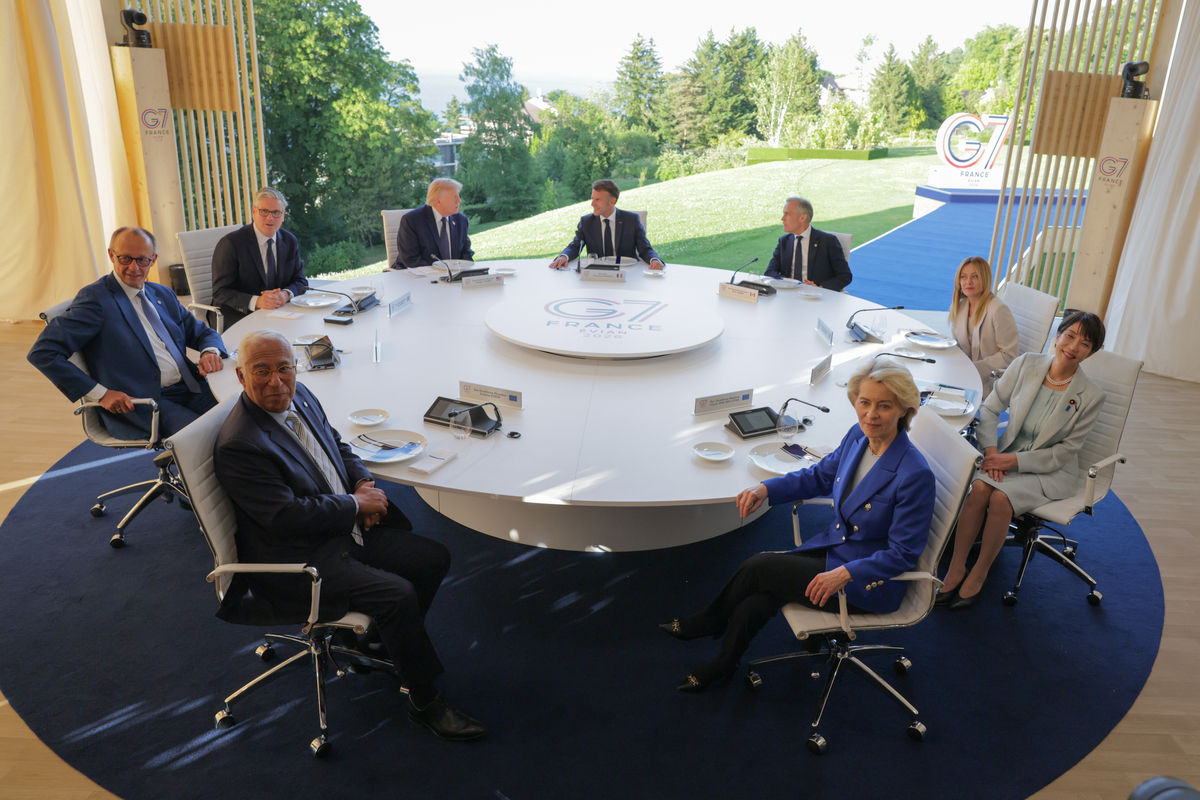
2026 G7 summit Évian-les-Bains, Haute-Savoie
Évian-les-Bains, Thonon-les-Bains, Haute-Savoie, Auvergne-Rhône-Alpes, France métropolitaine, 74500, France

International Relations
Technology Governance
Environmental Policy
10 min read
Updated By: History Editorial Network (HEN)
Published:
Updated:
The 2026 G7 summit was held from 15 to 17 June 2026 in Évian-les-Bains, Haute-Savoie, France. It was hosted by French President Emmanuel Macron under France’s G7 presidency. The venue was symbolic because Évian had hosted the 2003 G8 summit, and the meeting came just over fifty years after the first G7-style summit at Rambouillet in 1975. France described it as a “G7 of convergence,” intended to show unity during war, trade pressure and technological change.
The core leaders were Emmanuel Macron of France, Donald Trump of the United States, Keir Starmer of the United Kingdom, Mark Carney of Canada, Friedrich Merz of Germany, Giorgia Meloni of Italy and Sanae Takaichi of Japan. The European Union was represented by António Costa and Ursula von der Leyen. France also used a wider “G7+” format by involving India, Kenya, South Korea, Brazil and Egypt. Volodymyr Zelenskyy joined the Ukraine session, while Qatar and the United Arab Emirates joined Middle East exchanges. The IMF, World Bank, African Development Bank and OECD participated in sessions.
The summit took place in a difficult geopolitical environment. Russia’s war against Ukraine remained central, while instability in the Middle East, the Strait of Hormuz, debt pressure, trade tensions, migration, drug trafficking, health emergencies and artificial intelligence also shaped the agenda. Instead of one broad final communiqué, leaders adopted nine statements on geopolitical issues, partnerships, balanced growth, cancer, Ebola, migrant smuggling, drug trafficking, critical minerals and safer digital space for minors.
Ukraine was one of the most important subjects. The G7 reaffirmed support for Ukraine’s freedom, sovereignty and territorial integrity, and expressed solidarity with Ukrainians suffering attacks on critical infrastructure and cultural heritage. Leaders agreed to increase air defence capacities, interceptors and long-range capabilities, and to consider licensing arrangements to expand Ukraine’s military production. They also promised support for Ukraine’s energy resilience before winter and discussed more pressure on Russia through sanctions and measures against the shadow fleet.
The Middle East was another major focus. Leaders welcomed a U.S.-Iran agreement intended to reduce instability and emphasised that safe, free transit through the Strait of Hormuz was essential for the global economy. They discussed a possible multinational defensive maritime initiative led by France and the United Kingdom to help protect merchant shipping if required. The summit also referred to Lebanon, Gaza and the West Bank, calling for humanitarian efforts, respect for sovereignty and steps to reduce violence.
Economic policy centred on more balanced, durable and resilient growth. The G7 recognised that uncertainty, trade tensions and supply pressures were affecting industries, households and vulnerable countries. Leaders discussed macroeconomic imbalances, including overcapacity and weak consumption in some economies, underinvestment in Europe, and wider fiscal pressures. They called for stable markets, secure trade, resilient supply chains and coordination before forums such as the G20. Egypt, Kenya and South Korea supported this statement, showing that the discussion extended beyond the G7.
Critical minerals became one of the clearest strategic outcomes. The G7 recognised that minerals and rare earths are vital for digital industries, clean energy, defence, electric vehicles and advanced manufacturing. Leaders committed to diversify supply chains, reduce dependence on single suppliers, strengthen processing and recycling, mobilise finance, improve transparency and support labour and environmental standards. The declaration included a goal to reduce dependence on a single supplier outside the G7 and partner countries for rare earths and permanent magnets to below 60 percent by 2030.
Health, security and digital policy also received attention. The G7 adopted a leaders’ call on cancer, focusing on data sharing, paediatric cancers, cancers with poor prognosis and access to quality care. Leaders also called for a coordinated response to the Bundibugyo Ebola outbreak, including emergency aid, vaccine and WHO-aligned procedures. They adopted declarations against migrant smuggling and drug trafficking. The call for a safer online space for minors addressed harmful content, cyberbullying, exploitation and risks from generative AI.
The 2026 Évian summit is significant because it showed a G7 trying to remain relevant in a divided world. Its main achievements were coordinated statements on Ukraine, the Middle East, critical minerals, growth, health, migration, drugs and online safety. It also showed France’s effort to widen the G7 conversation through partner countries and development institutions. The summit’s message was that democratic industrial powers still wanted to act together, but in a world where security, energy, supply chains and health are connected.
#G7Summit
#Évian-les-bains
#EmmanuelMacron
#GlobalIssues
#InternationalCooperation
Primary Reference
G7 ÉVIAN 2026

Explore the Life Moments of
 AI Twin