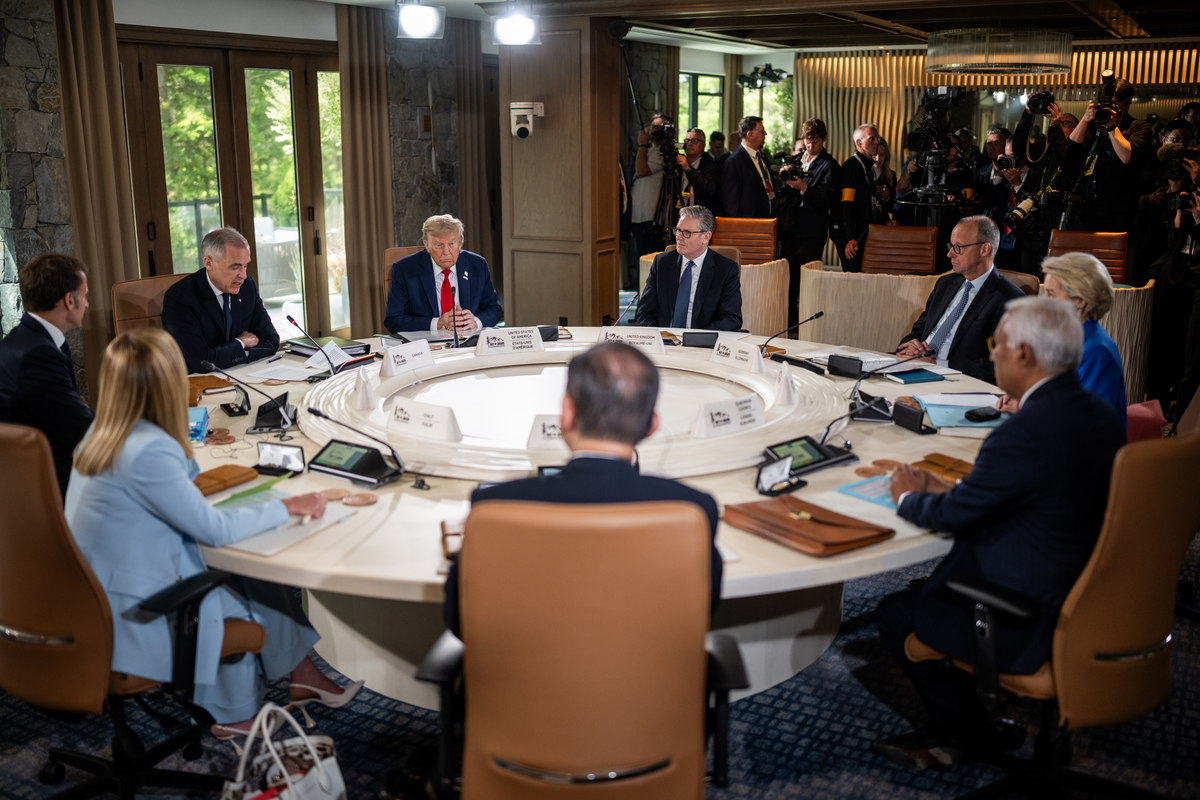
2025 G7 summit Kananaskis, Alberta
Kananaskis Improvement District, Alberta, Canada
International Relations
Military Support
Trade Agreements
10 min read
Updated By: History Editorial Network (HEN)
Published:
Updated:
The 2025 G7 summit, formally the 51st G7 leaders’ summit, was held in Kananaskis, Alberta, Canada, from 15 to 17 June 2025 under Canada’s presidency. It was hosted by Canadian Prime Minister Mark Carney and took place in the Rocky Mountains, the same region where Canada had hosted the 2002 G8 summit. The meeting also carried symbolic importance because it came fifty years after the first summit of leading industrial democracies in 1975. Its overall purpose was to coordinate action among major advanced economies at a time of rising geopolitical tension, trade uncertainty, technological change, energy concerns and pressure on global institutions.
The main G7 leaders present were Mark Carney of Canada, Donald Trump of the United States, Keir Starmer of the United Kingdom, Emmanuel Macron of France, Friedrich Merz of Germany, Giorgia Meloni of Italy and Shigeru Ishiba of Japan. The European Union was represented by European Council President António Costa and European Commission President Ursula von der Leyen. Several non-G7 partners also joined selected sessions, including Volodymyr Zelenskyy of Ukraine, Narendra Modi of India, Anthony Albanese of Australia, Luiz Inácio Lula da Silva of Brazil, Claudia Sheinbaum of Mexico, Cyril Ramaphosa of South Africa and Lee Jae-myung of South Korea. UN Secretary-General António Guterres, World Bank President Ajay Banga and NATO Secretary General Mark Rutte also participated in relevant discussions.
The summit’s broad priorities were framed around making communities safer, strengthening international security, promoting energy security, accelerating the digital transition and building partnerships for the future. Unlike some earlier summits, the 2025 meeting did not produce one comprehensive final leaders’ communiqué. Instead, leaders issued a Chair’s Summary and several targeted joint statements. This reflected both the complexity of the agenda and the political difficulty of reaching full consensus on every issue, especially amid sharp trade tensions, the war in Ukraine, conflict in the Middle East and different approaches among leaders.
Economic security was one of the central themes. Leaders discussed market volatility, international trade shocks, global imbalances, industrial competitiveness and the need for a more predictable trading system. They also addressed the risks created by unfair non-market policies, market distortion and harmful overcapacity. Critical minerals received special attention because they are essential for advanced manufacturing, defence, clean energy and digital technologies. The G7 Critical Minerals Action Plan focused on diversifying supply chains, encouraging responsible investment, supporting local value creation, strengthening standards and reducing dependence on vulnerable or concentrated sources.
Ukraine remained a major subject. President Zelenskyy joined leaders for discussions on support for a strong and sovereign Ukraine. The G7 recognised Ukraine’s acceptance of an unconditional ceasefire and stated that Russia should do the same. Leaders also underlined their willingness to explore further pressure on Russia, including financial sanctions, while continuing support for Ukraine’s defence, recovery and reconstruction. Canada used the summit to announce additional support for Ukraine, including military assistance, security-related support and loan disbursement through the G7 Extraordinary Revenue Acceleration mechanism, which uses revenues connected to immobilised Russian assets.
The Middle East became one of the most urgent issues during the summit because of the escalation between Israel and Iran. The G7 issued a statement affirming its commitment to peace and stability in the region, supporting Israel’s security, stressing the protection of civilians and stating that Iran must never obtain a nuclear weapon. Leaders also urged broader de-escalation, including movement toward a ceasefire in Gaza, and said they were ready to coordinate to protect international energy market stability. U.S. President Donald Trump left the summit early because of the Middle East crisis, which added to the sense that the meeting was taking place during a highly unstable global moment.
Technology was another defining area of the summit. The G7 Leaders’ Statement on AI for Prosperity promoted secure, responsible and trustworthy artificial intelligence, with emphasis on public-sector use, support for small and medium-sized enterprises, workforce preparation, trusted cross-border data flows and the energy demands of AI systems. Leaders also discussed the need to close digital divides with emerging market and developing country partners. In a separate quantum technologies statement, they recognised the importance of quantum computing, sensing and communications, while also noting the security risks such technologies could create for data protection and defence. The summit also addressed community safety and resilience.
#mooflife
#MomentOfLife
#G7Summit
#Kananaskis
#Twelve-dayWar
#MarkCarney
#InternationalRelations
Primary Reference
G7 Summit 2025

Explore the Life Moments of
 AI Twin