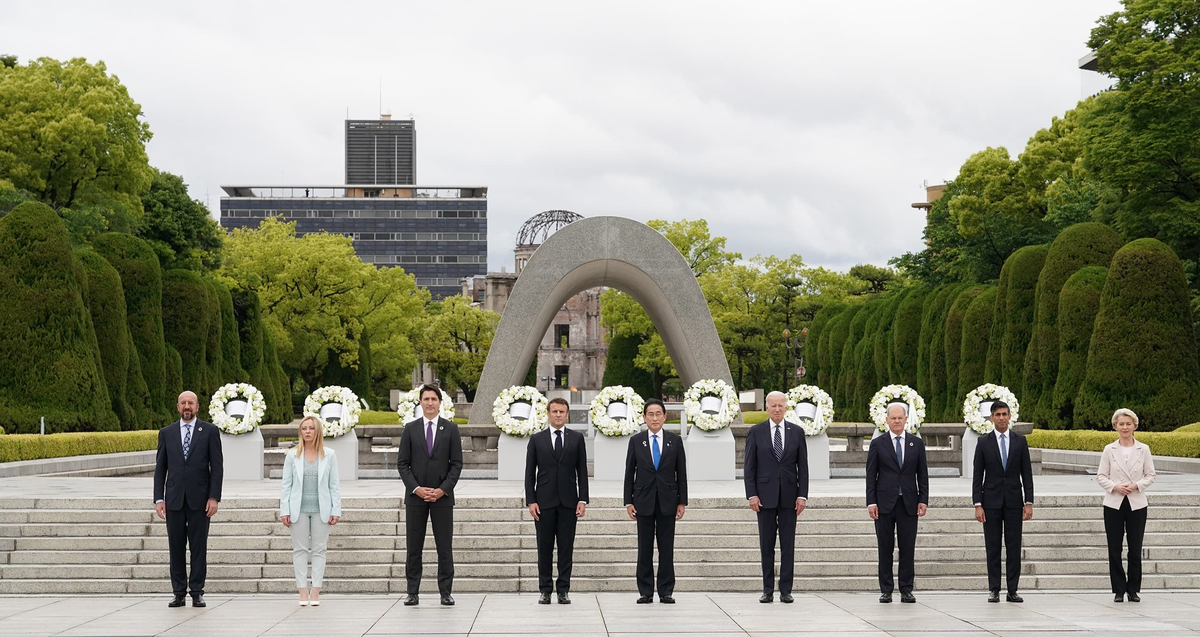
2023 G7 summit Hiroshima, Hiroshima Prefecture
Hiroshima, Japan

International Relations
Nuclear Disarmament
Global Security
10 min read
Updated By: History Editorial Network (HEN)
Published:
Updated:
The 2023 G7 summit was held in Hiroshima, Japan, from 19 to 21 May 2023 under Japanese Prime Minister Fumio Kishida. Hiroshima gave the meeting unusual symbolic weight because the city was destroyed by the first atomic bombing in 1945 and later became a global symbol of peace and nuclear disarmament. The main venue was the Grand Prince Hotel Hiroshima, and leaders also visited the Peace Memorial Museum and laid flowers at the Cenotaph for Atomic Bomb Victims.
The leaders present were Fumio Kishida of Japan, Joe Biden of the United States, Rishi Sunak of the United Kingdom, Emmanuel Macron of France, Olaf Scholz of Germany, Giorgia Meloni of Italy and Justin Trudeau of Canada. The European Union was represented by Charles Michel and Ursula von der Leyen. Japan invited leaders from Australia, Brazil, Comoros, the Cook Islands, India, Indonesia, South Korea and Vietnam, reflecting outreach to the Global South and Indo-Pacific. The UN, IEA, IMF, OECD, World Bank, WHO and WTO joined relevant discussions.
The summit took place during a tense period shaped by Russia’s war against Ukraine, food and energy insecurity, inflation, debt stress in developing countries, climate pressure, competition with China and rapid advances in artificial intelligence. Japan framed the meeting around defending an international order based on the rule of law and strengthening cooperation with partners beyond the G7. The leaders’ communiqué presented the group as united behind the UN Charter, territorial integrity, human rights, sustainable development and open economic systems.
Ukraine was the most urgent security issue. The G7 condemned Russia’s invasion as a grave violation of international law and promised support for Ukraine for as long as necessary. Leaders committed to expanding diplomatic, financial, humanitarian and military assistance, tightening sanctions, restricting exports useful to Russia’s war machine, preventing sanctions evasion and limiting Russian revenue from energy and metals. Ukrainian President Volodymyr Zelenskyy attended in person, giving the summit global attention and making Hiroshima a stage for solidarity against aggression.
Nuclear disarmament and non-proliferation were central because of Hiroshima’s history. The G7 issued the Hiroshima Vision on Nuclear Disarmament, reaffirming the goal of a world without nuclear weapons while recognising the harsh security environment. Leaders opposed Russia’s nuclear rhetoric, supported the Nuclear Non-Proliferation Treaty, urged transparency on nuclear arsenals, called for progress on the Comprehensive Nuclear-Test-Ban Treaty and expressed concern over North Korea’s nuclear and missile programmes and Iran’s nuclear activities.
Economic resilience and economic security formed another major pillar. The G7 discussed supply-chain risks, critical minerals, non-market policies, economic coercion, technology leakage, cyber threats and protection of critical infrastructure. Leaders said their approach to China and global supply chains would be based on “de-risking, not decoupling,” meaning they did not seek to cut economic ties but wanted to reduce vulnerabilities. They also launched coordination against economic coercion and reaffirmed rules-based trade with the WTO at its core.
The summit addressed the Indo-Pacific, China and regional security. Leaders supported a free and open Indo-Pacific, opposed unilateral attempts to change the status quo by force or coercion, and stressed peace across the Taiwan Strait. They raised concerns about the East and South China Seas, human rights, and constructive relations with China where possible. North Korea’s ballistic missile launches and nuclear programme were criticised, linking European and Asian security under one rule-of-law message.
Climate, energy, development and health also received major attention. The G7 reaffirmed net zero by 2050, the need to keep 1.5°C within reach, and support for clean energy, renewable expansion, energy efficiency and secure critical mineral supply chains. The Hiroshima Action Statement for Resilient Global Food Security addressed hunger and long-term food systems, while leaders highlighted Ukraine’s role in grain supplies and called for the Black Sea Grain Initiative to continue. They also supported the SDGs, development bank reform, PGII infrastructure finance, universal health coverage and pandemic preparedness.
Technology and artificial intelligence received special attention because generative AI had rapidly entered public debate. Leaders called for discussion on trustworthy AI, democratic values, interoperability and risk-based governance, leading to the Hiroshima AI Process. The summit combined crisis management with long-term strategy. It strengthened G7 unity on Ukraine, elevated nuclear disarmament through Hiroshima’s symbolism, deepened economic-security cooperation, reached out to emerging partners and showed how the G7 was adapting to war, climate risk and technological disruption.
#G7Summit
#Hiroshima
#NuclearDisarmament
#GlobalSouth
#EconomicSecurity
Primary Reference
G7 Hiroshima Summit

Explore the Life Moments of
 AI Twin