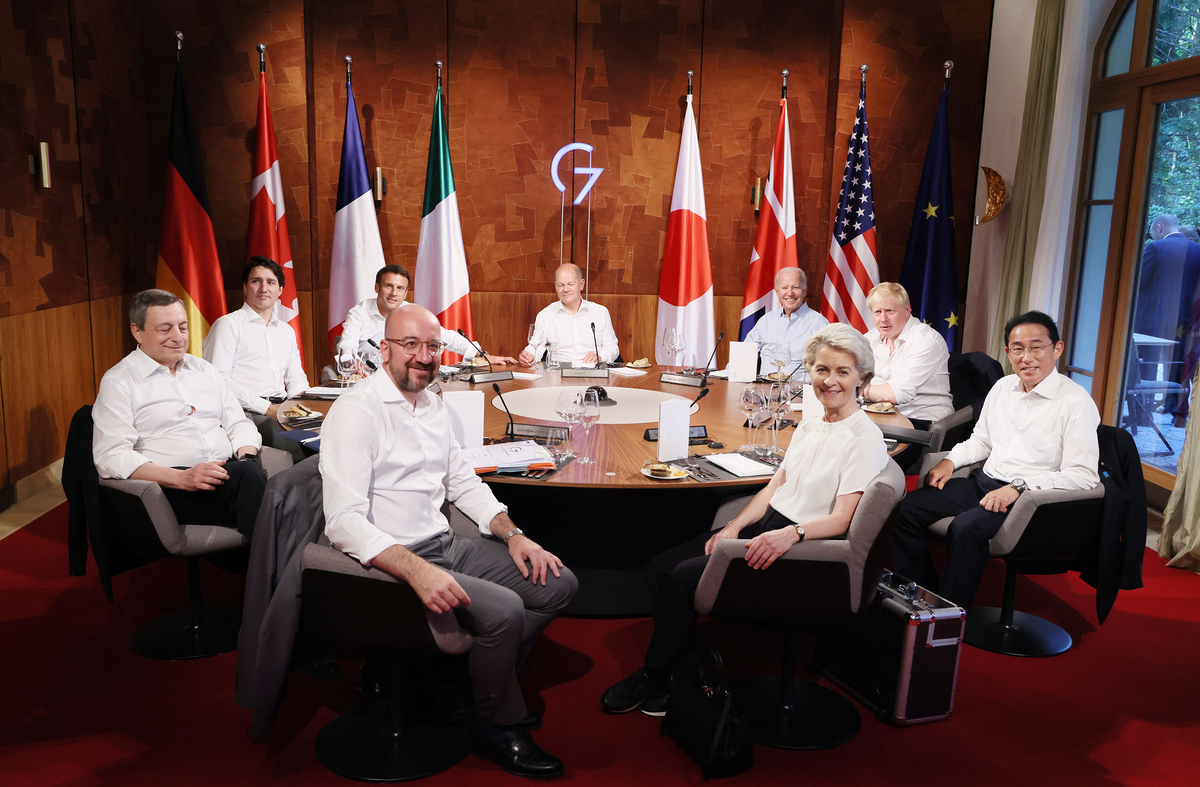
2022 G7 summit Krün, Bavaria
Schloss Elmau, 2, In Elmau, Elmau, Krün, Landkreis Garmisch-Partenkirchen, Bayern, 82493, Deutschland, Germany

International Relations
Climate Change
Global Security
10 min read
Updated By: History Editorial Network (HEN)
Published:
Updated:
The 2022 G7 summit, the 48th G7 summit, was held 26–28 June 2022 at Schloss Elmau in the Bavarian Alps near Krün, Germany. It was hosted by German Chancellor Olaf Scholz under the theme “Progress towards an equitable world.” The meeting came four months after Russia’s invasion of Ukraine, so an agenda of pandemic recovery, climate, development and stability became dominated by war, sanctions, inflation, energy insecurity and food shortages.
The leaders present were Olaf Scholz of Germany, Joe Biden of the United States, Boris Johnson of the United Kingdom, Emmanuel Macron of France, Mario Draghi of Italy, Justin Trudeau of Canada and Fumio Kishida of Japan. The European Union was represented by Charles Michel and Ursula von der Leyen. Germany invited Argentina, India, Indonesia, Senegal and South Africa to selected sessions, showing the effort to engage major emerging economies outside the G7. Ukrainian President Volodymyr Zelenskyy joined by video link, while the UN, IMF, World Bank, WHO, WTO, OECD, IEA and ILO joined discussions.
Ukraine was the summit’s central political and security issue. The G7 condemned Russia’s war as illegal, unjustifiable and unprovoked, and promised to stand with Ukraine for as long as necessary. Leaders committed to financial, humanitarian, military and diplomatic support, and backed Ukraine’s future reconstruction through an international recovery plan. They agreed to maintain severe sanctions on Russia, restrict access to key technologies and financial resources, reduce Russia’s energy revenues, counter sanctions evasion and support accountability for violations of international law.
The war strongly shaped the economic agenda. Leaders said Russia’s invasion had worsened inflation, disrupted supply chains, raised food and energy prices and increased pressure on vulnerable economies. They promised policy coordination, support for households facing cost-of-living shocks, financial stability and open markets. Trade discussions focused on World Trade Organization reform, resisting protectionism, supply-chain resilience and unfair non-market practices. Economic stability was linked to sanctions enforcement and reducing strategic dependence.
Energy security and climate policy had to be balanced carefully. The G7 reaffirmed commitment to the Paris Agreement, net zero emissions no later than 2050 and keeping the 1.5°C target within reach. Leaders supported a highly decarbonised road sector by 2030, a mainly decarbonised power sector by 2035 and faster phase-out of unabated coal power. Because Europe was reducing dependence on Russian energy, they acknowledged that temporary liquefied natural gas investment could be necessary if it avoided long-term fossil-fuel lock-in. They also endorsed a Climate Club to accelerate decarbonisation.
Food security was another major concern. Russia’s invasion disrupted grain exports, fertiliser supplies and agricultural markets, increasing hunger risks in poorer countries. The G7 committed to strengthen the Global Alliance for Food Security, support the UN and World Bank response, keep food and fertiliser markets open, avoid unjustified export restrictions and assist exposed countries. The summit treated food security as humanitarian and geopolitical, because hunger, debt stress and price shocks could destabilise societies beyond Europe.
The summit advanced infrastructure and development cooperation. The G7 launched the Partnership for Global Infrastructure and Investment, aiming to mobilise up to 600 billion US dollars in public and private investment over five years for sustainable infrastructure in developing and emerging economies. Leaders supported Just Energy Transition Partnerships, building on South Africa’s example and exploring partnerships with India, Indonesia, Senegal and Vietnam. Development discussions covered debt, the SDGs, climate finance and Africa partnerships.
Health and pandemic preparedness remained important. The G7 reaffirmed support for equitable access to vaccines, therapeutics, diagnostics and essential medical goods, and referred to the provision of more than one billion vaccine doses during the previous year. Leaders endorsed the G7 Pact for Pandemic Readiness to improve early warning, surveillance, rapid response and coordination before future health emergencies. They also supported stronger health systems, universal health coverage and antimicrobial resistance action.
Democratic values formed a wider theme. The G7 and partner countries issued a Resilient Democracies Statement committing to defend human rights, rule of law, gender equality, open debate and independent media. They discussed disinformation, foreign interference, cyber threats and online freedom. The summit is remembered as one of the most crisis-driven G7 meetings. Its main outcomes were unity on Ukraine, pressure on Russia, food and energy security, infrastructure investment, a Climate Club, pandemic-readiness commitments and democratic outreach.
#mooflife
#MomentOfLife
#G7Summit
#Ukraine
#GlobalCooperation
#ClimateChange
#FoodSecurity

Explore the Life Moments of
 AI Twin