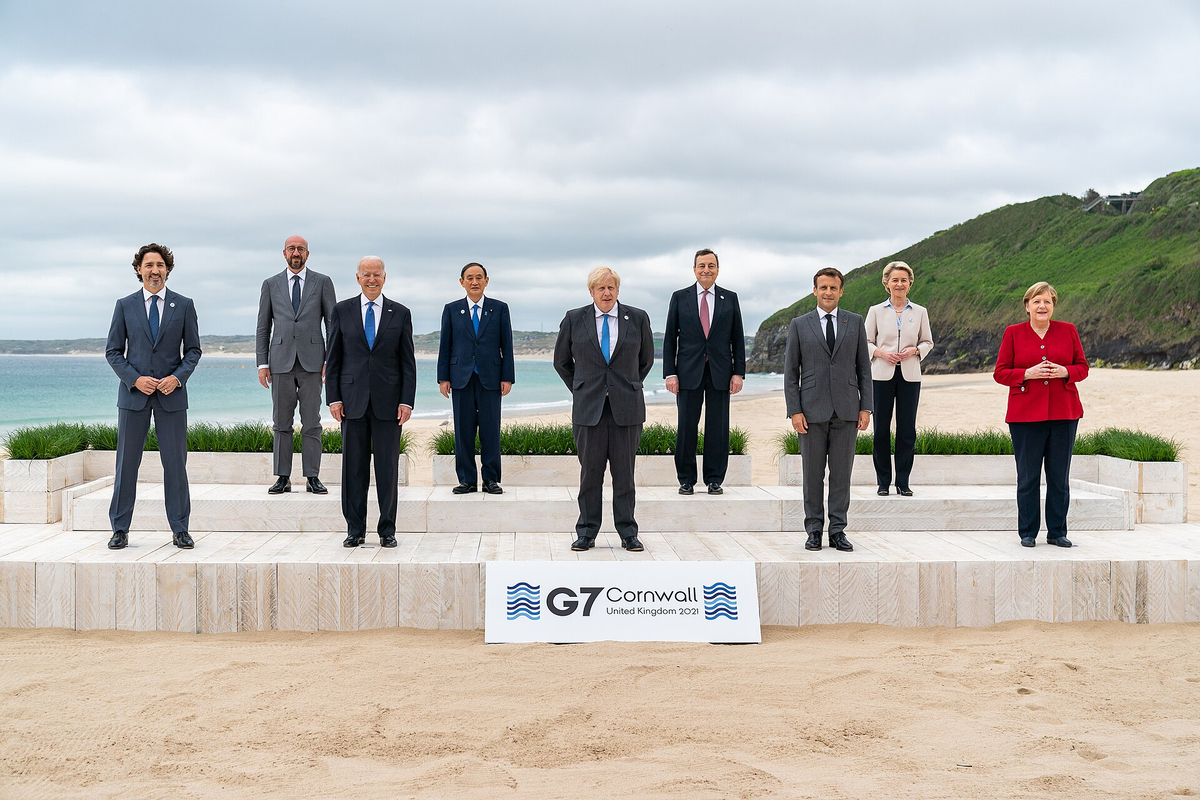
2021 G7 Summit in Cornwall Focuses on COVID-19 Recovery and Climate Action
Carbis Bay, Cornwall, United Kingdom
'%3e%3cpath fill='%23012169' d='M0 0v30h60V0z'/%3e%3cpath stroke='%23fff' stroke-width='6' d='m0 0 60 30m0-30L0 30'/%3e%3cpath stroke='%23C8102E' stroke-width='4' d='m0 0 60 30m0-30L0 30' clip-path='url(%23b)'/%3e%3cpath stroke='%23fff' stroke-width='10' d='M30 0v30M0 15h60'/%3e%3cpath stroke='%23C8102E' stroke-width='6' d='M30 0v30M0 15h60'/%3e%3c/g%3e%3c/svg%3e)
Health
Political
Economy
10 min read
Updated By: History Editorial Network (HEN)
Published:
The 2021 G7 summit, formally the 47th G7 leaders’ summit, was held from 11 to 13 June 2021 in Carbis Bay, Cornwall, in the United Kingdom. It was hosted by British Prime Minister Boris Johnson under the UK’s G7 presidency and carried the theme of “Building Back Better” after COVID-19. It was the first in-person G7 leaders’ summit since the pandemic began and followed the cancellation of the 2020 summit, making it both a diplomatic reopening and a test of whether advanced democracies could coordinate a fair global recovery.
The leaders present were Boris Johnson of the United Kingdom, Joe Biden of the United States, Justin Trudeau of Canada, Emmanuel Macron of France, Angela Merkel of Germany, Mario Draghi of Italy and Yoshihide Suga of Japan. The European Union was represented by Charles Michel and Ursula von der Leyen. It was Biden’s first G7 as U.S. president, Draghi’s first as Italian prime minister, Suga’s only G7 as Japanese prime minister and Merkel’s final G7 as German chancellor. The UK invited Australia, India, South Korea and South Africa as guest countries, with Narendra Modi joining virtually.
COVID-19 dominated the summit. Leaders committed to intensify global vaccination and stated that G7 commitments since the start of the pandemic amounted to more than two billion vaccine doses, including one billion doses over the following year from commitments made since February 2021 and at Carbis Bay. They supported COVAX, the ACT-Accelerator, vaccine manufacturing expansion and stronger supply chains. The Carbis Bay Health Declaration aimed to improve prevention, detection, response and recovery for future pandemics, with the World Health Organization at the centre of global health cooperation.
A major health legacy was the “100 Days Mission,” a proposal to make safe and effective vaccines, treatments and diagnostics available within the first 100 days of a future pandemic threat being identified. It reflected one of COVID-19’s main lessons: scientific innovation could move quickly, but only with better surveillance, data sharing, manufacturing capacity, regulation and equitable distribution. Leaders also supported stronger health systems, universal health coverage, antimicrobial-resistance action and preparedness for diseases passing from animals to humans.
The economic agenda focused on recovery from the pandemic and avoiding the unequal outcomes seen after the 2008 financial crisis. Leaders backed support for jobs, inclusive growth, resilient supply chains and fairer global taxation. The summit endorsed the breakthrough reached by G7 finance ministers on international tax reform, including a global minimum corporate tax of at least 15 percent and new rules to tax large multinational companies more fairly where they operate. This was one of the most concrete economic outcomes and later fed into wider G20 and OECD processes.
Climate change and nature protection were central because the UK was preparing to host COP26 in Glasgow later in 2021. The G7 reaffirmed the Paris Agreement, net zero emissions no later than 2050 and stronger 2030 targets. Leaders promised to end new direct government support for unabated international thermal coal power generation, increase climate finance, support a green transition and protect biodiversity. The G7 2030 Nature Compact committed members to halt and reverse biodiversity loss by 2030 and conserve or protect at least 30 percent of land and ocean areas.
Development and education also received attention. Leaders supported the Sustainable Development Goals, debt relief efforts, food security and recovery finance for vulnerable countries. Girls’ education was highlighted through commitments to get more girls into school and improve learning. The summit also launched the Build Back Better World initiative, intended as a values-driven infrastructure partnership for developing countries, especially in climate, health, digital technology and gender equity.
Foreign policy discussions reflected concern about authoritarian pressure and strategic competition. Leaders supported open societies, human rights, democracy, rule of law, media freedom and civic space through an Open Societies Statement joined by G7 members and guest democracies. They addressed Russia, Belarus, Myanmar, Libya, Syria, Iran and North Korea, and called for stability in the Indo-Pacific. The communiqué referred to peace across the Taiwan Strait, concerns in the East and South China Seas, and human rights issues including Xinjiang and Hong Kong.
The 2021 G7 summit is remembered as a reopening moment for summit diplomacy after the worst phase of the pandemic and as an attempt to reassert democratic cooperation. Its main outcomes were vaccine and pandemic-readiness commitments, the Carbis Bay Health Declaration, the 100 Days Mission, support for global tax reform, climate and nature commitments, girls’ education pledges, infrastructure cooperation and a wider message on open societies.
#G7
#G7Summit2021
#CarbisBay
#Cornwall
#BorisJohnson

Explore the Life Moments of
 AI Twin