EU–Mercosur Trade Agreement Signed
Asunción, Paraguay
Trade
7 min read
Updated By: History Editorial Network (HEN)
Published:
Updated:
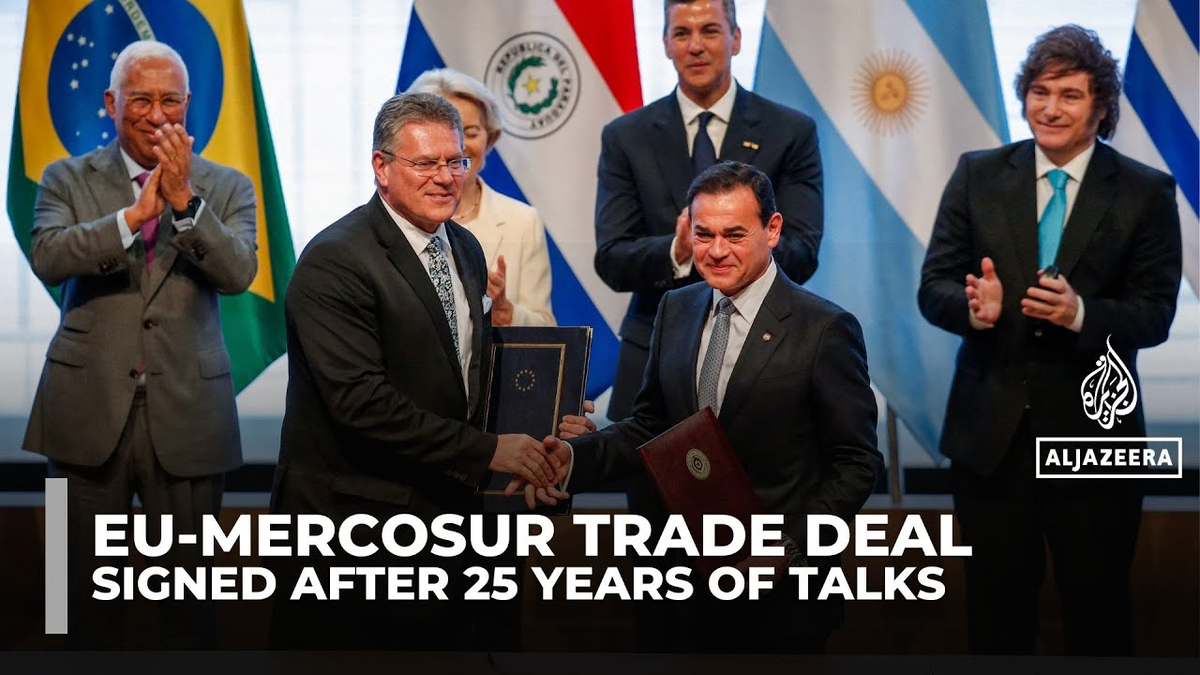
On 17 January 2026, EU and Mercosur officials held a signing ceremony in Asunción following EU authorization to sign. The EU signed two parallel legal instruments:
• EU–Mercosur Partnership Agreement (EMPA) (political dialogue, cooperation, and trade), and
• Interim Trade Agreement (iTA) (trade and investment commitments intended to apply ahead of full EMPA entry into force).
Key people present (as reported):
• Ursula von der Leyen (President of the European Commission)
• António Costa (President of the European Council)
• Presidents/leaders from Mercosur member states attended; Brazil’s President Luiz Inácio Lula da Silva did not attend and sent a representative.
What the agreement covers (key terms and areas)?
The trade pillar (reflected in the iTA and also included in the broader EMPA) covers, among other areas:
• Tariffs and rules of origin
• Technical barriers to trade and sanitary/phytosanitary measures
• Services (including barriers affecting cross-border services such as digital and financial services)
• Government procurement (access to public tenders in Mercosur countries)
• Intellectual property
• Sustainable development and SMEs
Reported trade-liberalization impact includes a gradual elimination of more than 90% of tariffs, across products “from Argentine beef to German cars,” and a combined market referenced as over 700 million people/consumers.
Economic context (official EU trade figures) - From the EU’s trade data for the four founding Mercosur countries:
• In 2024, EU exports to Mercosur were €53.3B, and Mercosur exports to the EU were €57.0B.
• Mercosur exports to the EU in 2024 were led by agricultural products (42.7%) and mineral products (30.5%).
• EU exports to Mercosur in 2024 included machinery and appliances (28.1%), chemicals/pharmaceuticals (25%), and transport equipment (12.1%).
• In 2023, EU services exports to Mercosur were €28.5B, while Mercosur services exports to the EU were €13.1B.
Timeline leading to the signing (start-to-signing)
• 1999: EU–Mercosur relations framed by an inter-regional framework cooperation agreement entering into force.
• 2000: EU–Mercosur negotiations for a trade deal began; 2016: negotiations were relaunched with renewed offers and intensified rounds.
• 06-Dec-2024: EU and the four founding Mercosur members reached a political agreement on a comprehensive partnership.
• 03-Sep-2025: European Commission proposed Council decisions to sign/advance the EMPA and iTA.
• 09-Jan-2026: EU Council gave the green light to sign both agreements.
• 17-Jan-2026: Signing ceremony in Paraguay (Asunción).
Status after signing (what had to happen next)
• EU side: the European Parliament’s consent is required for the EU to conclude the agreements (and further steps follow).
• Mercosur side: ratification by the legislatures of Argentina, Brazil, Paraguay, and Uruguay is part of the process described in reporting.
• The iTA is designed as a standalone trade instrument until the broader partnership agreement enters into force, and is described as needing EU-level ratification (not individual EU member-state ratifications) in the Council’s explanation.
• Reporting in late January 2026 indicated provisional application could begin as early as March 2026 after an initial Mercosur ratification step, while EU parliamentary/legal steps could also affect timing.
Parties: European Union (EU) and Mercosur (Argentina, Brazil, Paraguay, Uruguay)
#EU-Mercosur
Primary Reference
EU-Mercosur agreements explained
Explore the Life Moments of
 AI Twin