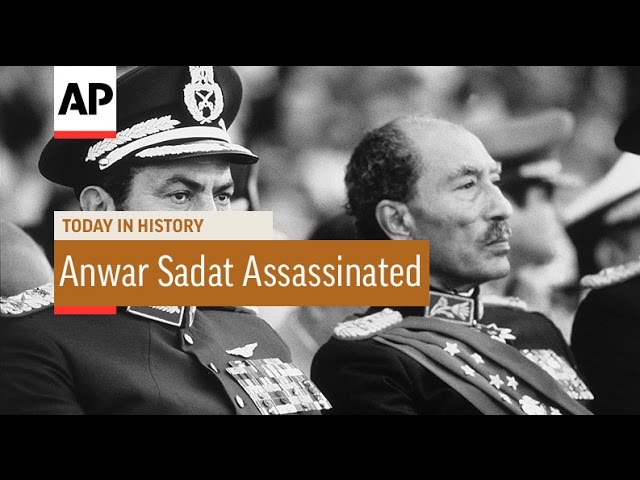
Assassination of Anwar Sadat
Egypt

Political
7 min read
Updated By: History Editorial Network (HEN)
Published:
The assassination of Anwar Sadat, the third President of Egypt, occurred on October 6, 1981, during a military parade in Cairo celebrating the eighth anniversary of Egypt's victory in the Yom Kippur War. This event marked a significant turning point in Middle Eastern history and had profound implications for Egypt's domestic and foreign policies.
Anwar Sadat, who became President of Egypt in 1970 following the death of Gamal Abdel Nasser, was known for his bold and often controversial policies. One of his most notable actions was initiating peace negotiations with Israel, which led to the signing of the Camp David Accords in 1978. The peace treaty with Israel, finalized in 1979, made Egypt the first Arab country to officially recognize Israel, earning Sadat the Nobel Peace Prize but also generating significant domestic and regional backlash.
Despite the international acclaim for his peace efforts, Sadat faced considerable opposition at home. Many Egyptians and other Arabs viewed the peace treaty as a betrayal of the Palestinian cause and a capitulation to Western interests. Sadat's regime also clamped down on political dissent, arresting thousands of opposition figures, including Islamists, leftists, and liberals. This repression, combined with economic difficulties and widespread corruption, exacerbated public discontent.
A militant Islamist group called Egyptian Islamic Jihad (EIJ) spearheaded the plot to assassinate Sadat. The EIJ, along with other radical groups, viewed Sadat's secular policies and peace treaty with Israel as an affront to Islamic principles and Arab nationalism.
On the day of the assassination, Sadat was presiding over a parade commemorating Egypt's crossing of the Suez Canal during the Yom Kippur War. The parade was a significant annual event, showcasing Egypt's military prowess. On October 6, 1981, Sadat, dressed in his military uniform, watched the parade from a reviewing stand alongside his vice president, Hosni Mubarak, and other high-ranking officials.
As the parade progressed, a military truck stopped abruptly in front of the reviewing stand. At first, the unexpected halt seemed to be part of the show. Suddenly, a group of soldiers, led by Lieutenant Khalid Islambouli, leapt from the truck and charged towards the stand. Islambouli threw a grenade, and his accomplices opened fire with automatic rifles. The attack lasted only a few moments but left Sadat and several others dead or wounded.
Anwar Sadat was pronounced dead shortly after the attack. His assassination plunged Egypt into a state of shock and mourning. Vice President Hosni Mubarak, who was wounded in the attack, quickly assumed the presidency. Mubarak's government imposed a state of emergency, cracking down on Islamist groups and political opponents to stabilize the country.
Internationally, Sadat's assassination was condemned, and it raised concerns about the stability of the Middle East. Despite his controversial policies, Sadat was seen as a pivotal figure in the pursuit of peace in the region. His death underscored the deep divisions and volatility in Egyptian society and the broader Arab world.
#MomentsOfLife #MoofLife_Moment #MoofLife #AnwarSadat #EgyptianHistory #MiddleEastPeace
Primary Reference
Assassination of Anwar Sadat

Explore the Life Moments of
 AI Twin