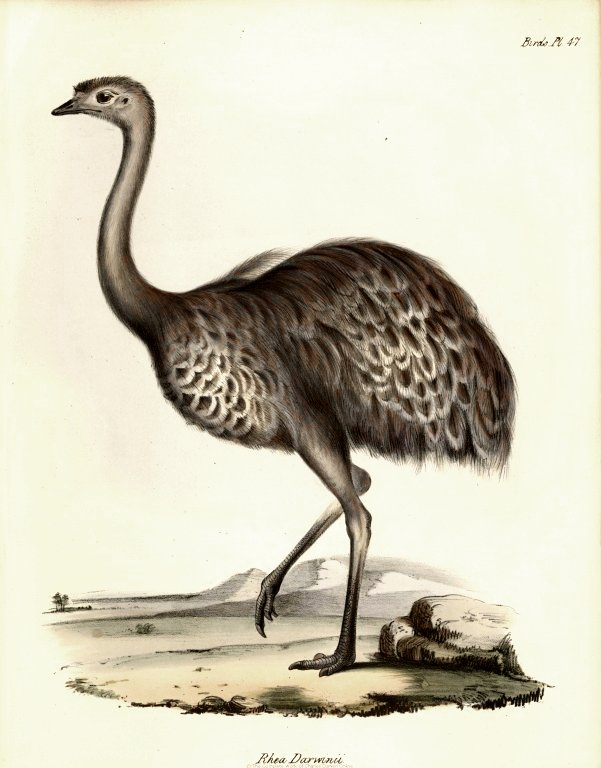
Darwin's Rhea Distribution: Insights on Speciation and Geographic Variation
United Kingdom
Science
Evolutionary Biology
4 min read
Updated By: History Editorial Network (HEN)
Published:
Updated:
Charles Darwin presented his findings on the geographic distribution of two distinct species of rhea to the scientific community. During his voyage on HMS Beagle, Darwin meticulously observed and collected specimens of rheas in South America. He noted that the larger rhea, Rhea americana, inhabited the regions to the north, while the smaller rhea, Rhea pennata (also known as the lesser rhea or Darwin's rhea), was found further south.
Darwin's observations highlighted the differences in the distribution of these two species and proposed that their distinct habitats played a crucial role in their divergence. This concept supported emerging ideas about adaptation and natural selection. Although taxonomy was not uniform, Darwin provided detailed morphological descriptions to differentiate the species, focusing on notable differences in size, feather patterns, and behaviors.
The impact of this announcement was far-reaching in the scientific community. It sparked further interest and debate on biogeography, speciation, and evolutionary mechanisms. Darwin's meticulous approach to his fieldwork and data collection played a key role in advancing the understanding of how environmental factors influence the development and distribution of species.
His findings on the rheas served as an early example of empirical evidence that shaped evolutionary biology, contributing to the foundation of his later work on the theory of natural selection.
#EvolutionaryBiology #FieldResearch #SpeciesDistribution #DarwinsDiscoveries #MoofLife

Explore the Life Moments of
 AI Twin