Darwin's Scientific Voyage on the HMS Beagle: Foundation of Evolutionary Theory
United Kingdom
Science
Exploration
4 min read
Updated By: History Editorial Network (HEN)
Published:
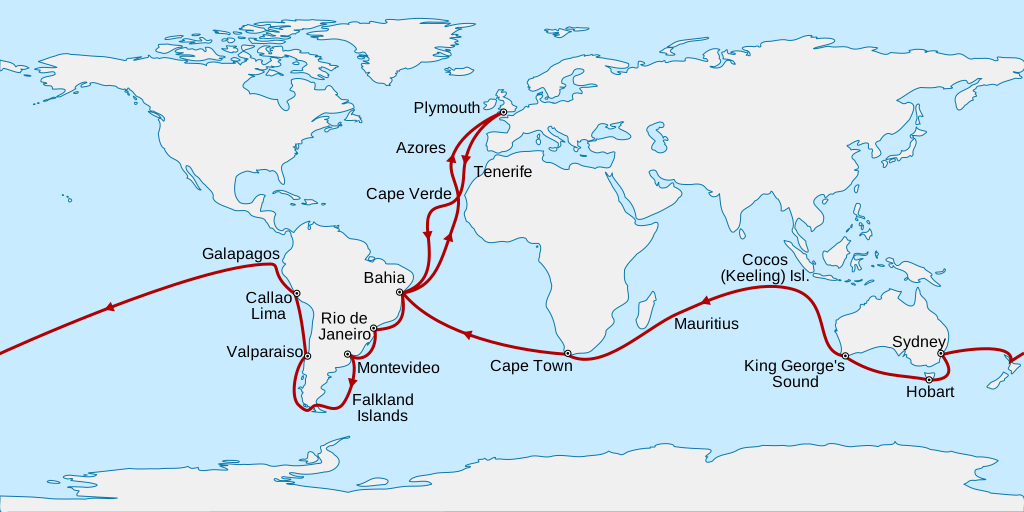
Charles Darwin departed from Plymouth aboard the HMS Beagle, embarking on a five-year scientific expedition aimed at charting the coastline of South America. Darwin, a naturalist, joined the voyage under the captaincy of Robert FitzRoy. His role on the Beagle involved studying the geology, flora, fauna, and indigenous cultures encountered during the journey.
The Beagle's mission primarily focused on hydrographic surveys, crucial for navigation and trade. However, Darwin's observations and collections during the voyage had broader implications. His meticulous notes on biological diversity and species distribution provided foundational data for his later works.
Darwin observed various geological formations, fossil records, and species adaptations. The Galápagos Islands proved particularly influential, where he noted the variations in finches' beak shapes. This played a critical role in developing his theory of natural selection. Darwin's findings challenged existing beliefs about the immutability of species and suggested a common ancestry.
The voyage of the Beagle significantly contributed to the field of biology. Darwin published his observations in "The Voyage of the Beagle," providing valuable insights into natural history. His work culminated in the groundbreaking "On the Origin of Species," fundamentally altering the understanding of biological evolution.
#MoofLife #Darwin #HMSBeagle #NaturalSelection #EvolutionTheory #ScientificVoyage #MarineSurvey #Biogeography
Explore the Life Moments of
 AI Twin