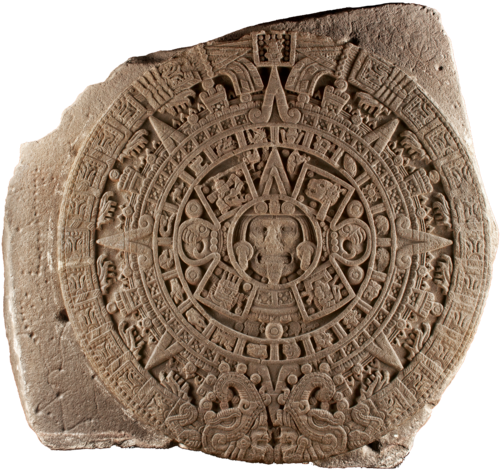
Discovery of the Aztec Sunstone
Mexico City, Mexico
Aztec Artifacts
Historical Monuments
Cultural Heritage
6 min read
Updated By: History Editorial Network (HEN)
Published:
Updated:
On 17/12/1790, workers carrying out repaving and repair work in the central plaza of Mexico City uncovered one of the most recognizable artifacts of ancient Mesoamerica: the Aztec Sun Stone, also known as the Piedra del Sol or Calendar Stone. The massive basalt sculpture was found buried near the Metropolitan Cathedral, in the heart of what had once been the Aztec capital of Tenochtitlan. Its rediscovery occurred during a period of urban reconstruction ordered by colonial authorities in New Spain, more than 250 years after the Spanish conquest of the Aztec Empire.
The stone measured approximately 3.6 meters in diameter, around 1.2 meters thick, and weighed an estimated 24 metric tons. Archaeologists and historians generally date its creation to the reign of the Mexica ruler Motecuhzoma II in the early 16th century, likely around 1502 to 1521. Carved from basalt, the monument contains intricate imagery associated with Aztec cosmology, solar cycles, mythology, and ritual symbolism. The central face is commonly identified as Tonatiuh, the Aztec sun deity, surrounded by symbols representing earlier cosmic eras and calendrical signs.
The discovery drew immediate attention from scholars and colonial officials. Antonio de León y Gama, a Mexican astronomer and antiquarian, studied the monument shortly after its excavation and published one of the earliest scholarly analyses in 1792. His work helped preserve important details about the stone’s symbolism and fueled growing intellectual interest in the civilizations that existed in Mexico before Spanish colonization. The excavation also coincided with the rediscovery of another major Mexica sculpture, the statue of Coatlicue, found earlier the same year in Mexico City.
After its excavation, the Sun Stone was initially mounted on the exterior wall of the Metropolitan Cathedral, where it remained exposed to weather for decades. In 1885, it was transferred to the National Museum in Mexico City. Today, the monument is housed in the National Museum of Anthropology, where it remains one of the museum’s most visited artifacts and a central symbol of Mexica heritage and Mexican cultural history.
Although commonly referred to as the “Aztec Calendar Stone,” researchers debate its exact function. Some interpretations suggest it served as a ceremonial altar or cosmological monument rather than a practical calendar. Its imagery reflects the Aztec understanding of cyclical time, sacred ritual, and the relationship between divine forces and political authority in late Postclassic Mesoamerica.
Historical Significance
The rediscovery of the Aztec Sun Stone in 1790 helped renew scholarly and public interest in the Indigenous civilizations of Mexico at a time when colonial narratives often minimized pre-Hispanic history. Over the following centuries, the monument became one of the most widely recognized visual symbols associated with the Mexica civilization and the historical identity of Mexico itself.
#mooflife
#MomentOfLife
#AztecSunstone
#Calendarstone
#MesoamericanCulture
#ArchaeologicalDiscovery
#MexicanHeritage
Primary Reference
Aztec sun stone

Explore the Life Moments of
 AI Twin