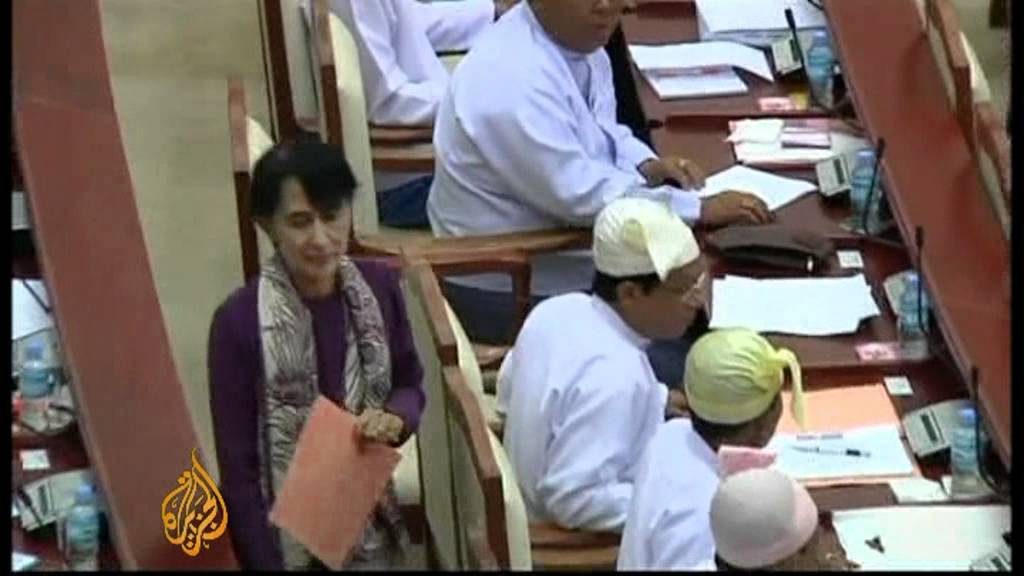
Aung San Suu Kyi takes oath and office
Nay Pyi Taw, Myanmar
Politics
Human Rights
Democracy
10 min read
Updated By: History Editorial Network (HEN)
Published:
Updated:
On 02/05/2012, Myanmar opposition leader Aung San Suu Kyi was sworn into the country’s parliament in Nay Pyi Taw, marking the first time she held elected public office after decades as a dissident leader and years spent under house arrest. The ceremony followed the 01/04/2012 parliamentary by-elections, in which her party, the National League for Democracy (NLD), won a large majority of the contested seats.
Suu Kyi entered parliament alongside 42 other newly elected NLD members, taking their seats in Myanmar’s lower and upper houses. The by-elections filled a limited number of vacant parliamentary seats but were widely viewed as an indicator of the political opening that began after the military-backed government initiated reforms in 2011. Suu Kyi herself won a seat representing Kawhmu Township in the lower house, formally known as the Pyithu Hluttaw.
The swearing-in ceremony had been delayed for several days due to a dispute over the wording of the parliamentary oath. Newly elected NLD lawmakers objected to a clause requiring them to “safeguard” the 2008 Constitution, a charter drafted under military rule that the party had long criticized as undemocratic. After discussions within the party and with government officials, the NLD decided to proceed with the oath as written to avoid prolonging the political stalemate and to allow its representatives to begin their parliamentary work.
The oath-taking took place at Myanmar’s national parliament complex in Nay Pyi Taw, the country’s administrative capital. Suu Kyi’s entry into the legislature marked a transition from opposition figure to elected lawmaker. For many years she had been internationally known for leading the pro-democracy movement in Myanmar and for receiving the 1991 Nobel Peace Prize while under house arrest. Her participation in parliament placed her and her party within Myanmar’s formal political institutions for the first time since the NLD’s earlier electoral victory in 1990, which had not been recognized by the ruling military government.
The event followed political reforms introduced after the transfer of power from direct military rule to a nominally civilian government in 2011. Those reforms included the legalization of the NLD as a political party, the release of political prisoners, and the organization of the 2012 by-elections. Suu Kyi’s swearing-in on 02/05/2012 therefore marked the moment when the opposition leader formally assumed a legislative role in the country’s evolving political system.
● Aung San Suu Kyi, a prominent figure in Myanmar's political landscape and leader of the National League for Democracy (NLD), officially took her oath of office alongside other elected members of her party.q This event marked a pivotal moment in Myanmar's transition towards a more democratic governance structure after decades of military rule. The NLD had previously boycotted the political process, but the decision to take office was driven by a strategic choice to influence the legislative process from within. By joining the parliament, Suu Kyi and her colleagues aimed to advocate for reforms and address the pressing issues facing the country, including human rights, economic development, and national reconciliation. The oath taken by Suu Kyi and her fellow lawmakers was significant, as it symbolized their commitment to engage with the political system, despite the unchanged wording of the oath, which had been a point of contention for many in the opposition. This move was seen as a pragmatic approach to effect change in a challenging political environment, where direct confrontation with the military-dominated government could have led to further repression.
The impact of Suu Kyi's ascension to office was profound, as it represented a shift in the political dynamics of Myanmar. Her presence in parliament provided a platform for the NLD to voice the concerns of the populace and push for legislative changes. The international community closely monitored these developments, recognizing the potential for a more open and democratic Myanmar. The decision to participate in the political process was also a response to the changing attitudes within the country, where there was a growing demand for democratic governance and accountability. The NLD's participation in parliament was a crucial step towards fostering dialogue and collaboration among various political factions, ultimately aiming to stabilize the nation and promote sustainable development. This transition was not without challenges, as the military retained significant power, but the engagement of Suu Kyi and her party in the legislative process was a critical factor in Myanmar's ongoing journey towards democracy.
#mooflife
#MomentOfLife
#AungSanSuuKyi
#MyanmarPolitics
#NationalLeagueForDemocracy
#DemocraticTransition
#LegislativeReform
Primary Reference
Aung San Suu Kyi takes oath at Burmese parliament

Explore the Life Moments of
 AI Twin