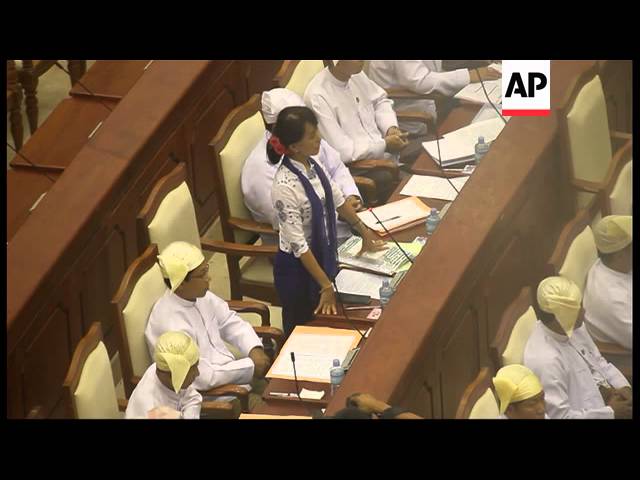
Aung San Suu Kyi attends Parliament as lawmaker
Naypyidaw, Myanmar
Politics
Human Rights
Legislative History
10 min read
Updated By: History Editorial Network (HEN)
Published:
Updated:
On 02/05/2012, Aung San Suu Kyi officially entered Myanmar’s parliament when she and other members of the National League for Democracy (NLD) took their oaths of office in Naypyidaw. The swearing-in ceremony marked her formal entry into the Pyithu Hluttaw, the lower house of Myanmar’s national legislature, after her party secured a sweeping victory in the April 2012 by-elections.
The parliamentary seat was won through the by-election held on 01/04/2012, where Suu Kyi ran as the NLD candidate for the Kawhmu constituency near Yangon. In the vote, she received a large majority of ballots cast, with estimates indicating that she gained roughly 75 percent to 82 percent of the vote. The NLD achieved a strong overall result in the by-elections, winning 43 of the 44 seats it contested across both houses of parliament. These by-elections were organized after earlier vacancies arose when sitting members of parliament joined the government following political reforms initiated by the administration of President Thein Sein.
Suu Kyi’s swearing-in was initially delayed because of a dispute between the NLD and parliamentary authorities over the wording of the oath. The constitution required lawmakers to pledge to “safeguard” the constitution, while the NLD proposed using the phrase “respect the constitution.” After about a week of negotiations, Suu Kyi and her fellow NLD representatives agreed to take the oath using the original wording, allowing them to take their seats and participate in legislative proceedings.
Her transition from a long period of house arrest to membership in parliament reflected the political changes occurring in Myanmar during the early 2010s. Suu Kyi had spent approximately 15 years under detention during the previous military government. Her participation in parliament signaled an effort by the NLD to engage with the existing political system in order to pursue democratic reforms and advocate for changes to the constitution.
Although the by-election allowed opposition representatives to enter parliament, the legislature continued to be dominated by the military-backed Union Solidarity and Development Party and by military appointees. Under the 2008 constitution, the armed forces were guaranteed 25 percent of the parliamentary seats, ensuring a continuing institutional role for the military in national governance.
Suu Kyi later made her first appearance during a regular legislative session of the Pyithu Hluttaw on 09/07/2012, where she began participating in debates and parliamentary activities as an elected lawmaker representing Kawhmu.
● Aung San Suu Kyi's entry into Parliament marked a pivotal shift in Myanmar's political landscape. After years of opposition and struggle against military rule, her decision to join the legislative process represented a strategic move to influence governance from within. Suu Kyi, a prominent figure in the pro-democracy movement, had previously maintained a boycott of the political system, which was largely controlled by the military. However, her and her colleagues' choice to participate as lawmakers was driven by the belief that they could effect more change by engaging directly in the political process rather than remaining outside of it. This decision was seen as a significant step towards democratic reform in Myanmar, as it allowed for greater representation of the National League for Democracy (NLD) within the government. The NLD's presence in Parliament provided a platform to advocate for policies that aligned with their vision for a democratic Myanmar, addressing issues such as human rights, economic development, and social justice.
The impact of Suu Kyi's attendance in Parliament extended beyond her immediate legislative role. It symbolized a broader acceptance of political participation for opposition parties in a country that had long been dominated by military rule. Her presence in the legislature was a source of hope for many citizens who had longed for democratic governance. The NLD's involvement in Parliament also led to increased international attention and support for Myanmar's political reforms. As a result, the country began to experience a gradual opening up, with various reforms being implemented to improve civil liberties and economic conditions. However, the challenges remained significant, as the military still held considerable power and influence over the political system. The transition to a fully democratic state continued to face obstacles, but Suu Kyi's role as a lawmaker was a crucial step in the ongoing struggle for democracy in Myanmar.
#mooflife
#MomentOfLife
#AungSanSuuKyi
#MyanmarPolitics
#Democracy
#NationalLeagueForDemocracy
#Parliament
Primary Reference
Suu Kyi takes parliamentary oath

Explore the Life Moments of
 AI Twin