Tower
Entertainment
5 min read
Updated By: History Editorial Network (HEN)
Published:
Updated:
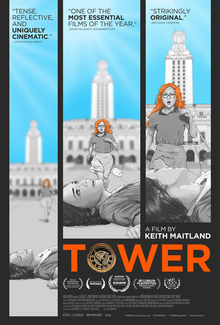
Tower (2016) is an American animated documentary directed by Keith Maitland and produced by Go‑Valley and ITVS. The film dramatizes the tragic 1966 sniper attack from the University of Texas Tower in Austin through rotoscoped reenactments and first‑person interviews. It weaves survivor testimony, archival footage, and graphic animation to build a haunting portrait of a campus under siege, highlighting both horror and heroism over the crucial 96‑minute event.
Visually, Tower blends live-action rotoscoping with archival material, overlaying animated sequences onto real campus imagery to reconstruct the geography and tension of that day. The technique gives the film an immediacy and emotional intimacy uncommon in traditional documentaries. The aesthetic choices—vividly animated gunfire, slow‑motion sequences, tight framing—imbue the narrative with cinematic suspense while honoring the real voices behind the story.
Though produced on a modest budget, Tower had a limited theatrical release and grossed around US $102,000, supported by strong festival showings. It debuted at South by Southwest and later received distribution through Kino Lorber and PBS's Independent Lens, spawning renewed public interest in historical mass shootings.
Critics praised the film for its sensitivity and innovation; it holds a 99% rating on Rotten Tomatoes. Reviewers highlighted its respectful handling of survivor experiences and its unique storytelling technique. Variety lauded it as “a gripping dramatic reconstruction,” while the Chicago Reader called its blend of animation and testimony a powerful new form of cinematic memorial.
The film won the 2016 Austin Film Critics Award for Best Documentary and later received a News & Documentary Emmy in 2018. It also earned nominations and wins at festivals worldwide, recognized for both its artistry and journalistic impact.
Tower’s legacy lies in its pioneering use of animation in documentary storytelling, demonstrating that animated reenactment can deepen emotional engagement without fictionalizing history. It stands as a powerful exploration of human resilience and cinematic innovation, influencing subsequent nonfiction works that blend art and reportage.
Primary Reference
Tower movie review & film summary (2016) | Roger Ebert

Explore the Life Moments of
 AI Twin