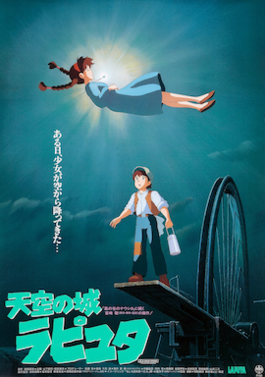
Castle in the Sky
Entertainment
6 min read
Updated By: History Editorial Network (HEN)
Published:
Updated:
Castle in the Sky (1986), known in Japan as Laputa: Castle in the Sky, is a landmark Japanese animated adventure fantasy directed by Hayao Miyazaki and produced by Studio Ghibli. It was the studio's first official feature and remains a cornerstone of its identity. The film follows Sheeta, a mysterious girl who possesses a magical pendant linked to the legendary floating city of Laputa. After escaping government agents and sky pirates, she teams up with Pazu, a brave orphan boy, as they journey to uncover the secrets of Laputa—a mythical city of science, power, and ruin. Their adventure becomes a race against time to prevent Laputa’s destructive technology from falling into the wrong hands.
Visually, Castle in the Sky is a breathtaking blend of steampunk aesthetics and natural wonder. The animation, entirely hand-drawn, showcases Miyazaki’s signature attention to detail—from the sprawling airborne landscapes and elaborate flying machines to expressive character animation and sweeping aerial sequences. The world feels massive and immersive, enriched by Joe Hisaishi’s stirring orchestral score, which blends whimsy and melancholy to underscore the film’s emotional highs and meditative moments.
With a production budget of around ¥500 million (roughly $4.5 million at the time), the film initially earned a modest ¥1.6 billion (~$13 million USD) in Japan. Though it was not a massive box office hit on release, it developed a strong following and has since become a cult favorite worldwide. Its influence grew through repeated TV airings in Japan and international releases, including a major English-language version produced by Disney in the early 2000s.
Critically, the film has been universally praised. It holds a 96% rating on Rotten Tomatoes and is often cited as one of Miyazaki’s most imaginative works. Reviewers applauded its world-building, action sequences, and thematic depth, noting its balance between anti-imperialist critique and childlike adventure. Its blend of environmentalism, pacifism, and wonder has made it especially resonant among Miyazaki’s catalog.
Castle in the Sky won the Animage Anime Grand Prix in 1986 and has since been honored in countless retrospectives as a defining moment in animation history. While it didn’t receive international awards upon release, its long-term impact has been profound—spawning countless tributes, fanworks, and inspiring works from directors like Guillermo del Toro and James Cameron.
The film’s legacy is enormous. It introduced key Miyazaki themes—flight, nature versus technology, strong young protagonists, and anti-war messaging—that would define Studio Ghibli’s identity. It also cemented the studio’s ability to produce deeply philosophical yet universally appealing stories. Castle in the Sky remains a masterclass in animation and storytelling, and a timeless reminder of how wonder and danger often come from the same place.

Explore the Life Moments of
 AI Twin