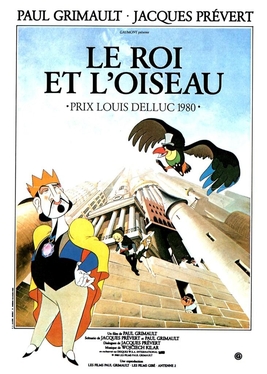
The King and the Mockingbird
Entertainment
6 min read
Updated By: History Editorial Network (HEN)
Published:
Updated:
The King and the Mockingbird (Le Roi et l’Oiseau, 1980) is a French animated fantasy directed by Paul Grimault, with screenplay by Grimault and Jacques Prévert, based on Hans Christian Andersen’s tale. Set in the whimsical kingdom of Tachicardia, the film centers on a clever mockingbird who mocks a despotic, cross-eyed king. When a painted shepherdess and chimney sweep spring to life, they attempt to escape the palace, aided by the mockingbird. Their struggle evolves into a broader uprising, weaving themes of rebellion, freedom, and the transformative power of art in a dreamlike narrative of resistance against tyranny.
Visually, the film is stunning—a celebration of mid-20th-century hand-drawn animation marked by surreal architecture, bold color contrasts, and imaginative character design. Deliberate pacing and minimalist motion amplify its allegorical punch, while striking scenes—like the king's giant robot—embrace the film’s surreal and satirical nature. Grimault’s animators complement Prévert’s poetic dialogue to create a whimsical yet pointed critique of power and conformity, framed through logically absurd world-building.
Though production began in 1948 and faced setbacks (a truncated 1952 version was released without the creators’ approval), Grimault regained control and finalized the film in 1980. Upon reissue in 2013, it became France’s highest-grossing re-release of that year, earning over €900,000, and continues to be a staple on screens curated by organizations like the Criterion Channel and Studio Ghibli Museum Library, introduced as a key influence on their animators.
Critically, it’s considered one of the greatest animated films ever made. With a 100% rating on Rotten Tomatoes and frequent inclusion in top-animated lists, it’s praised for its technical artistry, narrative daring, and allegorical complexity. Noted directors like Hayao Miyazaki and Isao Takahata cite it as a major inspiration, particularly its vertical composition and innovative use of space—a direct influence on films like The Castle of Cagliostro.
The film received the Prix Louis-Delluc in 1979, the Cannes Special Jury Prize in 1973 (for its incomplete version), as well as accolades including the Animage Grand Prix. Retrospectively, it’s honored in retrospectives, poll rankings, and academic studies as a masterwork of visual storytelling and imaginative world-building.
The legacy of The King and the Mockingbird is profound: it set a standard for auteur-driven animation, bridging political allegory with visual fantasy. Its influence on subsequent generations—most notably Studio Ghibli—marks it as a foundational work in global animation, showcasing how hand-drawn artistry can convey universal truths through whimsical poetry and dark humor.
Primary Reference
The King and the Mockingbird - Movie Reviews | Rotten Tomatoes

Explore the Life Moments of
 AI Twin