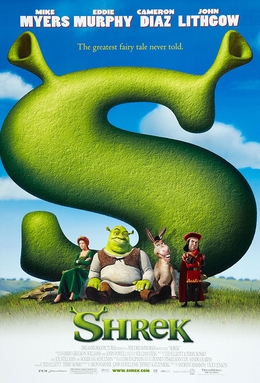
Shrek
Entertainment
6 min read
Updated By: History Editorial Network (HEN)
Published:
Updated:
Shrek (2001) is a landmark animated comedy film produced by DreamWorks Animation and directed by Andrew Adamson and Vicky Jenson. Based loosely on William Steig’s 1990 picture book, it tells the story of Shrek, a reclusive green ogre (voiced by Mike Myers) whose swamp is overrun by fairy tale creatures banished by the tyrannical Lord Farquaad (John Lithgow). To reclaim his solitude, Shrek agrees to rescue Princess Fiona (Cameron Diaz) from a dragon-guarded tower, with the loudmouthed but loyal Donkey (Eddie Murphy) at his side. What begins as a standard fantasy quest soon flips every trope on its head—revealing that Fiona has secrets of her own and that true love might be found in the most unexpected of places.
At its core, Shrek is a subversive parody of fairy tales and Disney traditions. The film's irreverent humor, contemporary references, and anti-princess narrative were revolutionary for early 2000s animation. Visually, it blended stylized CGI character animation with lush fantasy landscapes, utilizing early advancements in computer-generated imagery to craft a world that felt both absurd and oddly grounded. Its soundtrack—featuring Smash Mouth, Joan Jett, Rufus Wainwright, and others—was equally influential, giving the film a distinct pop culture identity.
Released on a budget of about $60 million, Shrek was a massive commercial success, grossing over $487 million worldwide. It outperformed expectations and quickly became one of the highest-grossing films of 2001. Its wide appeal—reaching both children and adults—helped solidify DreamWorks Animation as a serious rival to Pixar and Disney.
Critically, Shrek was highly praised for its wit, originality, and emotional sincerity beneath the sarcasm. It holds an 89% rating on Rotten Tomatoes and a Metacritic score of 84. Reviewers applauded Eddie Murphy’s energetic performance, Myers’ heartfelt delivery, and the way the film challenged the idea of beauty, heroism, and traditional happy endings.
Awards-wise, Shrek made history. It won the first-ever Academy Award for Best Animated Feature in 2002, beating out Monsters, Inc. and Jimmy Neutron: Boy Genius. It was also nominated for Best Adapted Screenplay, a rare honor for an animated film. It received multiple BAFTA and Annie Awards, further cementing its success.
The legacy of Shrek is enormous. It spawned three direct sequels, a spinoff (Puss in Boots), and a billion-dollar franchise including merchandise, theme park attractions, a Broadway musical, and internet meme immortality. Its cultural impact is still felt today—Shrek is often credited with ushering in a new era of self-aware, adult-savvy animation and remains a pop culture touchstone for its humor, heart, and unapologetic weirdness.
Primary Reference
Shrek

Explore the Life Moments of
 AI Twin