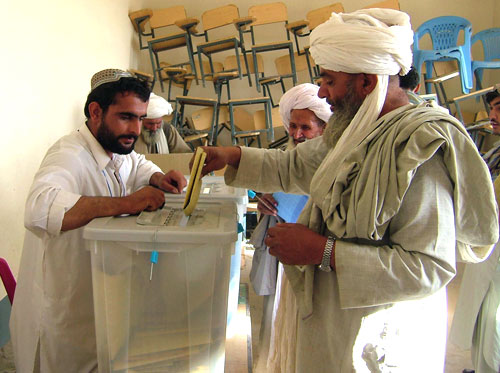
The Afghan parliamentary elections of 2005
Afghanistan
Political
Sustainability
9 min read
Updated By: History Editorial Network (HEN)
Published:
The Afghan parliamentary elections of 2005 were a significant milestone in the country's tumultuous journey towards establishing a democratic system after decades of conflict and instability. Held on September 18, 2005, these elections were the first parliamentary elections in Afghanistan since 1969, marking a crucial step in the post-Taliban nation-building process.
Context and Preparation
Following the fall of the Taliban regime in 2001, Afghanistan embarked on a path to rebuild its political institutions under the guidance of the Bonn Agreement of December 2001. This agreement laid the groundwork for establishing an interim government and planning for democratic elections. The first presidential elections were held in 2004, in which Hamid Karzai was elected as President. The 2005 parliamentary elections aimed to create a new legislature, consisting of the Wolesi Jirga (House of the People) and the Meshrano Jirga (House of Elders), thereby completing the transitional political framework outlined in the new Afghan Constitution adopted in 2004.
Election Mechanics
The 2005 parliamentary elections involved two major components:
Wolesi Jirga Elections: Members of the Wolesi Jirga, the lower house of the National Assembly, were directly elected. The body consists of 249 seats, with members elected through a Single Non-Transferable Vote (SNTV) system. This method allowed voters to cast a ballot for a single candidate in multi-member constituencies.
Provincial Council Elections: At the same time, elections were held for the provincial councils, which serve as the basis for selecting members of the Meshrano Jirga. Each province elects representatives to their respective councils, and these councils then choose members to send to the upper house.
Challenges
The elections faced numerous challenges:
Security: Afghanistan was still grappling with an insurgency led by the Taliban and other militant groups. There were significant concerns about voter safety and the security of election officials.
Logistics: Conducting elections in a country with rugged terrain and limited infrastructure posed logistical challenges, including the distribution of ballots and the setup of polling stations.
Political Fragmentation: The Afghan political landscape was highly fragmented, with numerous candidates and parties vying for power, making the political process complex and sometimes contentious.
Voter Participation and Inclusivity
Despite these challenges, the elections saw a robust voter turnout, with millions of Afghans participating. Efforts were made to ensure inclusivity, particularly for women and ethnic minorities. The Afghan Constitution mandates that at least 68 seats in the Wolesi Jirga be reserved for women, reflecting a significant step towards gender equality in a traditionally patriarchal society.
Election Outcomes
The results of the 2005 parliamentary elections were diverse, reflecting the complex mosaic of Afghan society. No single party gained a majority, leading to a fragmented Wolesi Jirga composed of various political factions, including former warlords, technocrats, and representatives of different ethnic and tribal groups. This diversity underscored the need for coalition-building and compromise in the new legislative body.
Impact and Legacy
The 2005 elections were a landmark in Afghanistan's democratic evolution. They represented a critical attempt to move beyond the autocratic rule and civil strife that had plagued the country for decades. The establishment of a functioning parliament aimed to provide a platform for dialogue and governance that included a broader spectrum of Afghan society.
While the elections did not immediately resolve Afghanistan's deep-seated issues, they laid a foundation for subsequent political processes. The new parliament played a role in shaping national policies and laws, although it often faced significant challenges due to ongoing conflict and political instability.
#AfghanElections #DemocracyInAfghanistan #PostTalibanEra #MomentsOfLife #MoofLife_Moment #MoofLife
Primary Reference
2005 Afghan parliamentary election
Explore the Life Moments of
 AI Twin