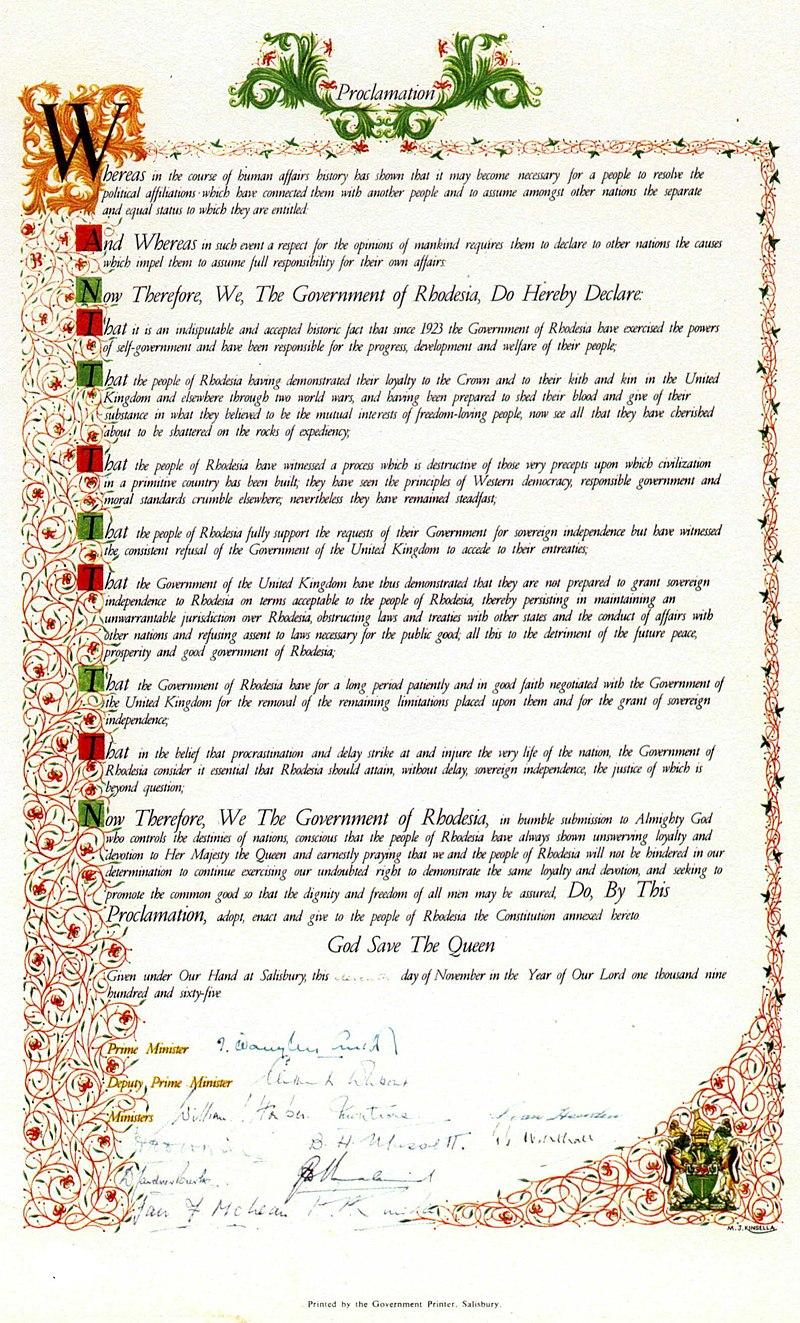
White minority government declares independence without international recognition.
Zimbabwe
Political
Decolonization
5 min read
Updated By: History Editorial Network (HEN)
Published:
The Unilateral Declaration of Independence (UDI) by the white minority government led by Ian Smith took place in a historical context marked by rising nationalist movements in Africa. Britain was in the process of decolonizing its African territories, and nationalist leaders in Rhodesia sought majority rule. However, the white minority, largely of European descent, pursued a different trajectory. They aimed to retain their economic privileges and political power.
Ian Smith, leading the predominantly white government, declared independence from Britain. This action was not recognized by the United Kingdom or by the international community. The British government opposed the move, emphasizing the need for majority rule and avoiding endorsing the white minority's governance. Consequently, the UN and other global organizations imposed economic sanctions on Rhodesia.
The economic sanctions targeted key sectors, including tobacco and minerals, the backbone of Rhodesia's economy. Despite these attempts, Rhodesia managed to sustain some trade through clandestine channels and the support of sympathetic states. However, the internal strife escalated, with nationalist groups like the Zimbabwe African National Union (ZANU) and the Zimbabwe African People's Union (ZAPU) intensifying guerrilla warfare against the government.
The UDI had profound impacts on the socio-political landscape. It fueled the liberation struggle, leading to significant displacement and loss of life, directly affecting both the rural and urban populations. The internal conflict persisted until the Lancaster House Agreement, which eventually led to recognized independence and the establishment of Zimbabwe.
Demographics during this period revealed a stark contrast between the minority white population, who constituted a small fraction, and the majority black African populace. The political and economic disparities were marked by skewed land ownership and wealth distribution.
This pivotal chapter in Zimbabwe's history is underscored by themes of colonial legacy, struggle for self-determination, and the quest for majority rule. It serves as a testament to the resilience of the indigenous population and the complex nature of decolonization in Africa.
#UnilateralDeclarationOfIndependence #Rhodesia #IanSmith #Zimbabwe #Decolonization #AfricanNationalism #GuerrillaWarfare #EconomicSanctions #MajorityRule #MoofLife
Primary Reference
Rhodesia's Unilateral Declaration of Independence - Wikipedia
Explore the Life Moments of
 AI Twin