Robert Mugabe ousted from power after military intervention
Zimbabwe
Military intervention
10 min read
Updated By: History Editorial Network (HEN)
Published:
On November 21, 2017, Robert Mugabe, who had ruled Zimbabwe for nearly four decades, was ousted from power following a military intervention. This marked the end of one of Africa’s longest-serving leaders and the conclusion of an era characterized by both liberation and authoritarianism in Zimbabwe. Mugabe's removal was met with widespread relief and celebration across the country, as it opened a new chapter in Zimbabwean politics.
Background: Mugabe’s Rule and Decline
Robert Mugabe had been a central figure in Zimbabwean politics since the country's independence from British colonial rule in 1980. He was a leader of the Zimbabwe African National Union (ZANU) during the liberation struggle and became the first Prime Minister of Zimbabwe, later transitioning to the role of President in 1987. Mugabe’s early years in power were marked by efforts to improve education and health services, but his rule increasingly became associated with economic decline, human rights abuses, and political repression.
By the 2000s, Zimbabwe was facing severe economic challenges, including hyperinflation, widespread poverty, and unemployment, largely as a result of controversial land reforms and international sanctions. Mugabe’s government responded to growing opposition with harsh crackdowns, rigged elections, and increasing authoritarianism. Over time, his popularity waned, even within his own party, the Zimbabwe African National Union-Patriotic Front (ZANU-PF).
The Lead-Up to the Ouster
The events that led to Mugabe’s ousting began with internal conflicts within ZANU-PF, particularly over Mugabe’s succession. As Mugabe aged—he was 93 in 2017—speculation grew about who would succeed him. Two main factions emerged within ZANU-PF: one supporting Vice President Emmerson Mnangagwa, a longtime ally of Mugabe and former head of the military and intelligence services, and another backing Mugabe’s wife, Grace Mugabe, who had gained significant influence in the party and appeared to be positioning herself as her husband’s successor.
Tensions reached a boiling point on November 6, 2017, when Mugabe dismissed Mnangagwa from his position as Vice President, ostensibly clearing the way for Grace Mugabe to succeed him. This move was deeply unpopular within the military and among Mnangagwa’s supporters in ZANU-PF. The dismissal triggered a response from the military, which had long been a key pillar of Mugabe’s rule but had grown increasingly concerned about the influence of Grace Mugabe and her faction, known as the G40.
The Military Intervention
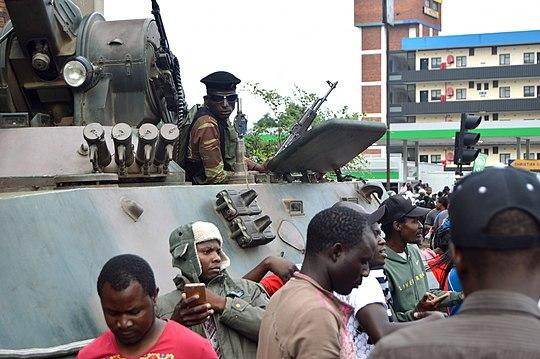
On the night of November 14-15, 2017, the Zimbabwean military, led by General Constantino Chiwenga, took control of key government institutions, including the state broadcaster, and placed Mugabe under house arrest. The military denied that it was staging a coup, insisting instead that it was targeting "criminals" around Mugabe who were causing social and economic harm.
Despite the military’s insistence that Mugabe remained the head of state, it was clear that his hold on power was slipping. Over the following days, pressure mounted on Mugabe to step down. Massive protests erupted across the country, with Zimbabweans taking to the streets to demand his resignation. The demonstrations were notable for their size and the rare unity among Zimbabweans, many of whom had suffered under Mugabe’s rule.
Mugabe’s Resignation
On November 19, 2017, ZANU-PF formally removed Mugabe as its leader and appointed Emmerson Mnangagwa in his place. The party also initiated impeachment proceedings against Mugabe in the Zimbabwean Parliament. Faced with the loss of support from his party, the military, and the public, Mugabe finally agreed to resign.
On November 21, 2017, as Parliament began the process to impeach him, Mugabe sent a letter to the Speaker of the House, announcing his resignation with immediate effect. His resignation was met with jubilation across Zimbabwe, with people celebrating in the streets, expressing relief and hope for a new beginning after decades of Mugabe’s authoritarian rule.
Aftermath and Legacy
Emmerson Mnangagwa was sworn in as President of Zimbabwe on November 24, 2017. He promised to lead the country towards a new era of economic recovery and political reform, although skepticism remained due to his close ties to Mugabe and his role in past government abuses, including the Gukurahundi massacres in the 1980s.
Mugabe’s ousting marked the end of an era in Zimbabwe, but it also raised questions about the future of the country. While his removal was seen as a necessary step towards change, the continuation of ZANU-PF's dominance and the military’s role in politics led to concerns about whether true democratic reforms would take place.
Robert Mugabe's legacy is deeply complex: he is remembered as a liberation hero who played a crucial role in ending colonial rule, but also as a dictator whose policies led to economic ruin and widespread suffering. His ousting in 2017 was a significant moment in Zimbabwe's history, symbolizing the potential for change, but also highlighting the challenges that lay ahead in the post-Mugabe era.
#MomentsOfLife #MoofLife_Moment #MoofLife #Zimbabwe #Mugabe #PoliticalChange #AfricanHistory #MilitaryIntervention #ZANUPF
Primary Reference
Zimbabwe's Coup: Net Gain or No Gain? Ambassador Linda ...
Explore the Life Moments of
 AI Twin