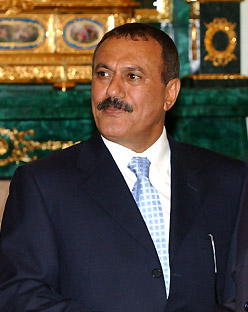
Saleh was elected as the country's first directly elected president through a presidential election
Yemen
Politics
Elections
Middle Eastern History
6 min read
Updated By: History Editorial Network (HEN)
Published:
Updated:
On 23/09/1999, Yemen held its first direct presidential election since the unification of North and South Yemen in 1990, resulting in the victory of President Ali Abdullah Saleh. The election marked the first time Yemeni citizens directly voted for a head of state in the unified republic, replacing the previous system in which the president was selected by parliament.
Ali Abdullah Saleh, leader of the General People’s Congress (GPC), won the election by a large margin, officially receiving approximately 96.3 percent of the vote. His only challenger was Najeeb Qahtan al Sha'abi, an independent candidate and fellow member of the ruling GPC. Al Sha'abi was the son of Qahtan Muhammad al Sha'abi, the first president of South Yemen after British withdrawal in 1967. Major opposition parties, including elements within the Islamist Islah party and other political groups, either boycotted the election or publicly supported Saleh rather than fielding strong competing candidates.
The election took place in the aftermath of significant political changes in Yemen during the 1990s. Following Yemeni unification in 1990, Saleh had initially served as president through parliamentary appointment and political agreements between northern and southern leadership factions. After the 1994 Yemeni civil war, in which northern forces defeated southern secessionists, Saleh consolidated his position as president of the unified country.
Under Yemen’s electoral rules at the time, presidential candidates required endorsement from parliament before appearing on the ballot, a condition criticized by some opposition figures and international observers as limiting broader political competition. Despite these criticisms, the 1999 vote was presented by the Yemeni government as an important step in the country’s formal democratic development. Voter turnout was reported to be high, and the election was closely monitored by regional and international observers.
Following Saleh’s victory, constitutional amendments approved in 2001 extended the presidential term from five years to seven years. Saleh remained in office for more than a decade afterward, surviving political unrest, armed conflicts, economic crises, and increasing domestic opposition. His presidency eventually came to an end in 2012 after mass protests linked to the Arab Spring uprising forced him to transfer power under a Gulf Cooperation Council mediated agreement.
Historical Significance
The 1999 presidential election represented a defining moment in Yemen’s post unification political system by introducing direct presidential voting at the national level. At the same time, the overwhelming result and limited opposition participation highlighted the concentration of political power around Ali Abdullah Saleh and the ruling establishment during that period of Yemeni history.
#mooflife
#MomentOfLife
#Yemen
#Saleh
#PresidentialElection
#Democracy
#PoliticalHistory
Primary Reference
Ali Abdullah Saleh

Explore the Life Moments of
 AI Twin