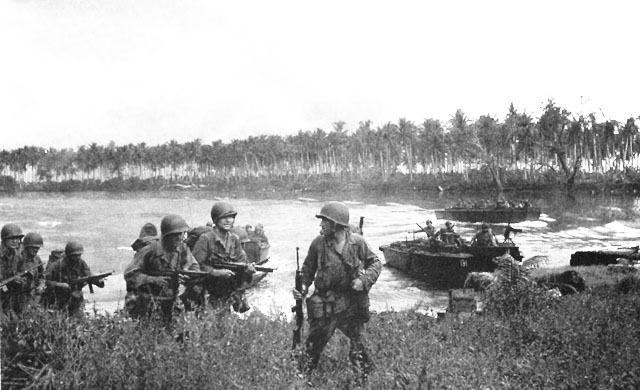
Admiralty Islands invaded by U.S. forces
Germany


'/%3e%3c/defs%3e%3cpath fill='%23012169' d='M0 0h10080v5040H0z'/%3e%3cpath stroke='%23fff' stroke-width='.6' d='m0 0 6 3m0-3L0 3' clip-path='url(%23b)' transform='scale(840)'/%3e%3cpath stroke='%23e4002b' stroke-width='.4' d='m0 0 6 3m0-3L0 3' clip-path='url(%23c)' transform='scale(840)'/%3e%3cpath stroke='%23fff' stroke-width='840' d='M2520 0v2520M0 1260h5040'/%3e%3cpath stroke='%23e4002b' stroke-width='504' d='M2520 0v2520M0 1260h5040'/%3e%3cg fill='%23fff'%3e%3cuse xlink:href='%23d' x='2520' y='3780'/%3e%3cuse xlink:href='%23a' x='7560' y='4200'/%3e%3cuse xlink:href='%23a' x='6300' y='2205'/%3e%3cuse xlink:href='%23a' x='7560' y='840'/%3e%3cuse xlink:href='%23a' x='8680' y='1869'/%3e%3cuse xlink:href='%23e' x='8064' y='2730'/%3e%3c/g%3e%3c/svg%3e)
Military History
World War II
Pacific Theater
4 min read
Updated By: History Editorial Network (HEN)
Published:
Updated:
The invasion of the Admiralty Islands by U.S. forces was a strategic military operation during World War II, primarily aimed at securing a vital fleet anchorage in the Pacific. This operation was marked by the Battle of Los Negros and was part of a broader campaign to gain control over key locations in the region. The Admiralty Islands, located northeast of New Guinea, were crucial for the U.S. Navy as they provided a base for further operations against Japanese-held territories. The invasion began with intense aerial and naval bombardments, followed by amphibious landings that faced resistance from Japanese forces. The U.S. troops engaged in fierce combat, which continued for several months, highlighting the challenges of island warfare in the Pacific theater.
The impact of the invasion was significant, as it effectively isolated Rabaul, a major Japanese stronghold, cutting off their supply lines and limiting their operational capabilities. The successful capture of the Admiralty Islands allowed the U.S. to establish airfields and logistical support for subsequent operations in the region, contributing to the overall strategy of island hopping. This campaign not only weakened Japanese defenses but also paved the way for future offensives in the Pacific, ultimately leading to the liberation of occupied territories. The Admiralty Islands invasion exemplified the complexities of military strategy during World War II and underscored the importance of securing key geographic locations in the fight against Japan.
#mooflife
#MomentOfLife
#AdmiraltyIslands
#UsForcesInvasion
#BattleOfLosNegros
#OperationBrewer
#WorldWarIi
Primary Reference
Admiralty Islands campaign

Explore the Life Moments of
 AI Twin