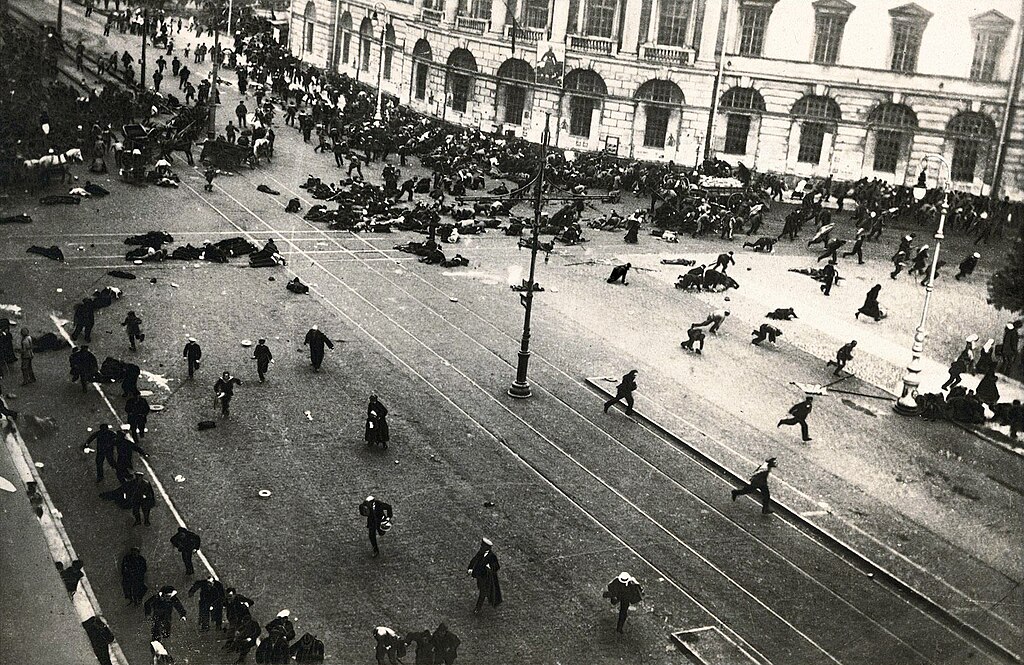
Suppression of July Days: Bolsheviks challenged Provisional Government, met by force, escalating tensions.
Germany
Political
5 min read
Updated By: History Editorial Network (HEN)
Published:
Updated:
Following the February Revolution and the abdication of Tsar Nicholas II, the Russian Provisional Government faced increasing challenges in maintaining authority and order. A significant episode during this tumultuous period was the suppression of the July Days protests in Petrograd. This unrest resulted from widespread dissatisfaction with the Provisional Government, driven primarily by the ongoing hardships of World War I, economic instability, and demands for greater political influence by various factions, including the Bolsheviks.
The Bolshevik leaders, advocating for a transfer of power to the soviets (workers' councils), galvanized discontented soldiers, workers, and sailors. Demonstrations involving approximately 500,000 people erupted in Petrograd, demanding the end of the Provisional Government. The authorities, perceiving the protests as a direct threat to their mandate, decided to act decisively.
Government troops and loyalist forces intervened to disperse the demonstrators. This action included open confrontations and the strategic arrest of prominent Bolshevik figures such as Leon Trotsky. Vladimir Lenin, another influential Bolshevik leader, evaded capture by going into hiding. The suppression of the July Days marked a temporary setback for the Bolshevik movement, resulting in a wave of arrests and escalating tension between the government and socialist factions.
The impact of these events was multifaceted. Politically, the crackdown showcased the Provisional Government's resolve to maintain control but also highlighted its reliance on military force. Consequently, this only served to deepen the existing rifts and reinforce the Bolsheviks' resolve. Socially, the cracked protests amplified the frustration of the urban working class and military personnel, setting the stage for future revolutionary activities.
Economically, the continuation of war exacerbated the struggles faced by ordinary Russians, fueling further unrest. The weakening of the Provisional Government's position, combined with the arrested leaders' martyr status, laid the groundwork for future upheavals.
#MoofLife #RussianHistory #Revolution #WorldWarI #BolshevikRevolution #PoliticalUnrest #SovietStudies
Explore the Life Moments of
 AI Twin