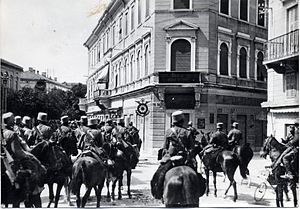
Italian Offensive at the Sixth Battle of the Isonzo: Stalled Progress at Austro-Hungarian Defenses.
Germany
Military
4 min read
Updated By: History Editorial Network (HEN)
Published:
Updated:
The Sixth Battle of the Isonzo began as Italian forces launched another offensive against Austro-Hungarian positions, focusing on breaking through entrenched defenses along the Isonzo River. This battle was part of a series of twelve battles fought between the Kingdom of Italy and the Austro-Hungarian Empire during World War I. The strategic goal for the Italians was to achieve a breakthrough into the enemy lines along the river in northern Italy.
Before the offensive, both sides had been engaged in a prolonged stalemate, with the terrain favoring defensive operations. The Isonzo River run through a mountainous region with narrow valleys, making it difficult for either side to secure a tactical advantage. The Italians aimed to exploit a perceived weakness in the Austro-Hungarian defenses by concentrating their artillery and infantry attacks on critical sections of the frontline.
The Italian Army mobilized a significant number of troops and artillery pieces. Despite the intense preparations and initial bombardments, the terrain's natural defenses and the well-fortified Austro-Hungarian positions hindered substantial progress. The Italians managed to capture a few key positions, including the town of Gorizia, but the offensive did not result in a decisive breakthrough.
The impact of this battle on the overall war effort was limited. Both sides suffered heavy casualties, contributing to the attrition warfare that characterized much of the conflict on the Italian Front. The broader strategic situation remained largely unchanged, with neither side able to gain a decisive upper hand.
#MoofLife #WorldWarI #ItalianFront #IsonzoBattles #MilitaryHistory
Primary Reference
Italian Front

Explore the Life Moments of
 AI Twin