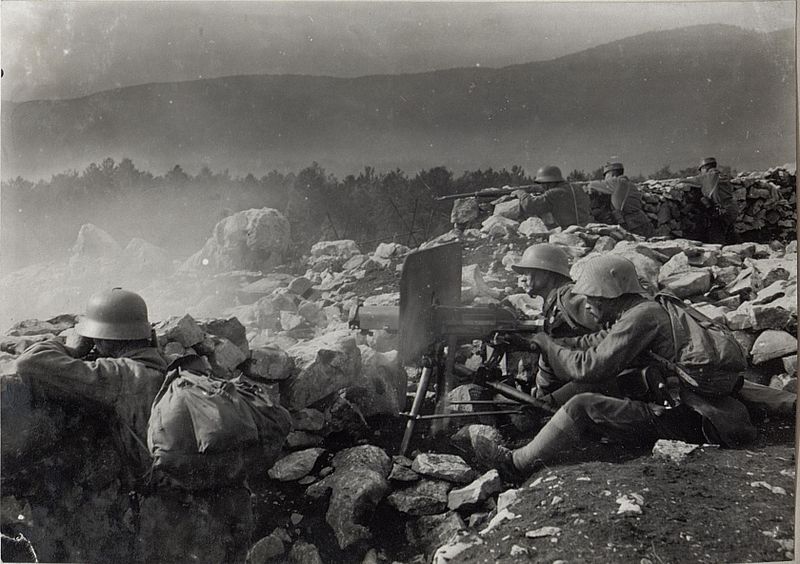
Italian Offensive at Tenth Battle of Isonzo: Costly Engagement in World War I
Germany
Military
4 min read
Updated By: History Editorial Network (HEN)
Published:
Updated:
The Tenth Battle of the Isonzo was an offensive launched by Italian forces against Austro-Hungarian positions along the Isonzo River during World War I. This battle was part of a larger series of engagements aimed at breaking through enemy lines and achieving a strategic advantage in the region. The Italian Army, led by General Luigi Cadorna, sought to exploit weaknesses in the Austro-Hungarian defenses by concentrating their attacks on specific sectors of the front.
The offensive involved intense artillery bombardments and infantry assaults aimed at dislodging well-entrenched Austro-Hungarian troops from their positions. Despite the extensive preparation and the numerical superiority of the Italian forces, the battle resulted in substantial casualties on both sides with limited territorial gain. Over approximately two weeks of fighting, the Italians suffered around 157,000 casualties, while Austro-Hungarian losses were estimated at 75,000. The limited success of the offensive was largely due to the strong defensive positions held by the Austro-Hungarian Army and the challenging mountainous terrain of the region.
This battle, like others along the Isonzo River, highlighted the brutal and often inconclusive nature of trench warfare during World War I. The high casualty rates and minimal gains underscored the difficulty of achieving decisive victories in such conditions. The Tenth Battle of the Isonzo did not significantly alter the strategic situation on the Italian Front, and both sides remained locked in a bloody stalemate for several more months.
#WorldWarI #ItalianFront #IsonzoRiver #MilitaryHistory #MoofLife
Primary Reference
Italian Front / 1.0 / handbook - 1914-1918-Online (WW1) Encyclopedia

Explore the Life Moments of
 AI Twin