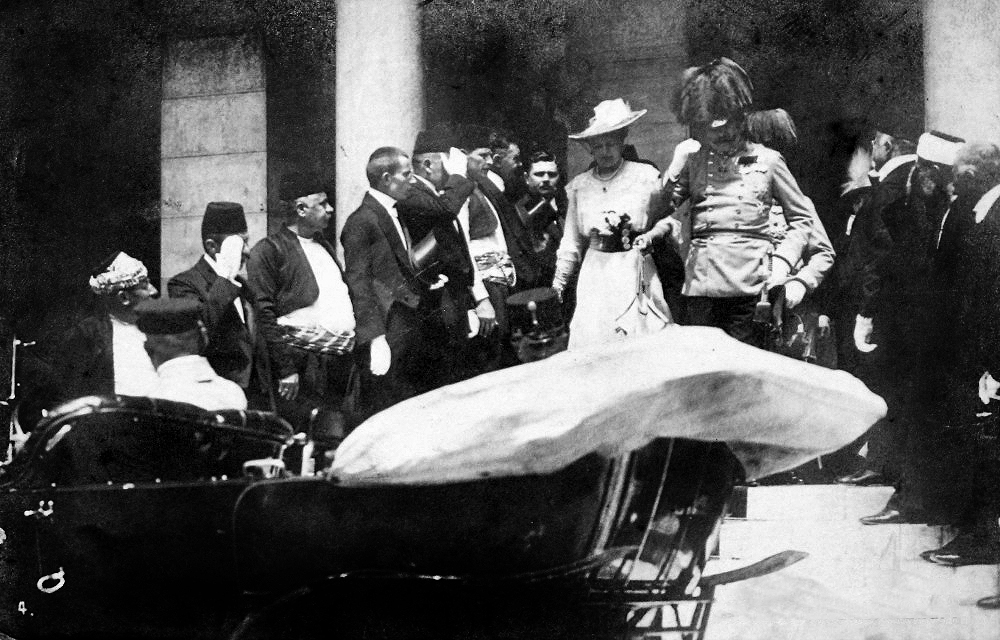
Assassination of Archduke Franz Ferdinand Sparks World War I
Germany
Political
Global Trade
4 min read
Updated By: History Editorial Network (HEN)
Published:
Updated:
Archduke Franz Ferdinand of Austria and his wife, Sophie, were assassinated in Sarajevo by Gavrilo Princip, a Bosnian Serb nationalist. This event is recognized as a pivotal point that triggered a series of actions leading to World War I. The Archduke was heir to the Austro-Hungarian throne, and his marriage to Sophie had been mired in controversy because it was considered a morganatic union, making their children ineligible for succession.
Gavrilo Princip, a member of the Black Hand, a secret society committed to the independence of Serbs from Austro-Hungarian rule, carried out the assassination as a form of protest and to promote nationalism. The assassination took place during an official visit by the Archduke and his wife to Sarajevo, Bosnia.
The killing set off a rapid chain reaction among the major powers in Europe, which were bound by a complex web of alliances and treaties. Austria-Hungary, with support from Germany, issued an ultimatum to Serbia. The subsequent rejection of part of the demands by Serbia led Austria-Hungary to declare war on Serbia. This declaration activated alliances, pulling in Russia, Germany, France, and eventually Great Britain, expanding the conflict to a global scale.
The assassination itself was not isolated but occurred in a context of rising ethnic tensions and nationalistic fervor in the Balkans, which had experienced significant upheaval over previous decades. The event highlighted the volatile state of international affairs and underscored the fragility of peace in Europe at the time.
#MoofLife #WorldWarI #ArchdukeFranzFerdinand #Assassination #Sarajevo #GavriloPrincip #AustriaHungary #SerbianNationalism #Bosnia
Primary Reference
June 28, 1914 | National WWI Museum and Memorial
Explore the Life Moments of
 AI Twin