Halifax Explosion: Catastrophic Event in World War I Canada
Germany
Tragedy Event
4 min read
Updated By: History Editorial Network (HEN)
Published:
Updated:
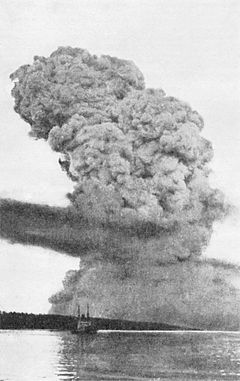
During World War I, in the bustling port city of Halifax, Canada, a catastrophic event occurred, profoundly impacting the city and its residents. A French munitions ship named SS Mont-Blanc, heavily loaded with explosives, was accidentally struck by a Norwegian vessel, SS Imo, while navigating the Narrows, a strait that connects the upper Halifax Harbour to Bedford Basin.
The collision ignited a fire on the Mont-Blanc, which then drifted to the Halifax shoreline, drawing curious onlookers. Unbeknownst to them, the ship's volatile cargo included picric acid, TNT, and benzol, substances exceedingly prone to explosion. Approximately 20 minutes after the collision, the Mont-Blanc detonated with an unprecedented force. The resulting explosion is recorded as one of the largest non-nuclear explosions in history, equivalent to almost three kilotons of TNT.
The immediate blast obliterated the surrounding area. Buildings were flattened, and infrastructure was decimated within a radius of approximately two kilometers. The force of the explosion shattered windows up to 80 kilometers away and was felt as far as Cape Breton, beyond 300 kilometers from the explosion site. A towering pressure wave swept through Halifax, causing widespread devastation.
The human toll was staggering. Estimates suggest that around 2,000 people were killed instantly or succumbed to injuries shortly after, while over 9,000 others were wounded, many severely. Debris and rubble buried survivors and victims alike, complic
Primary Reference
Halifax Explosion | The Canadian Encyclopedia

Explore the Life Moments of
 AI Twin