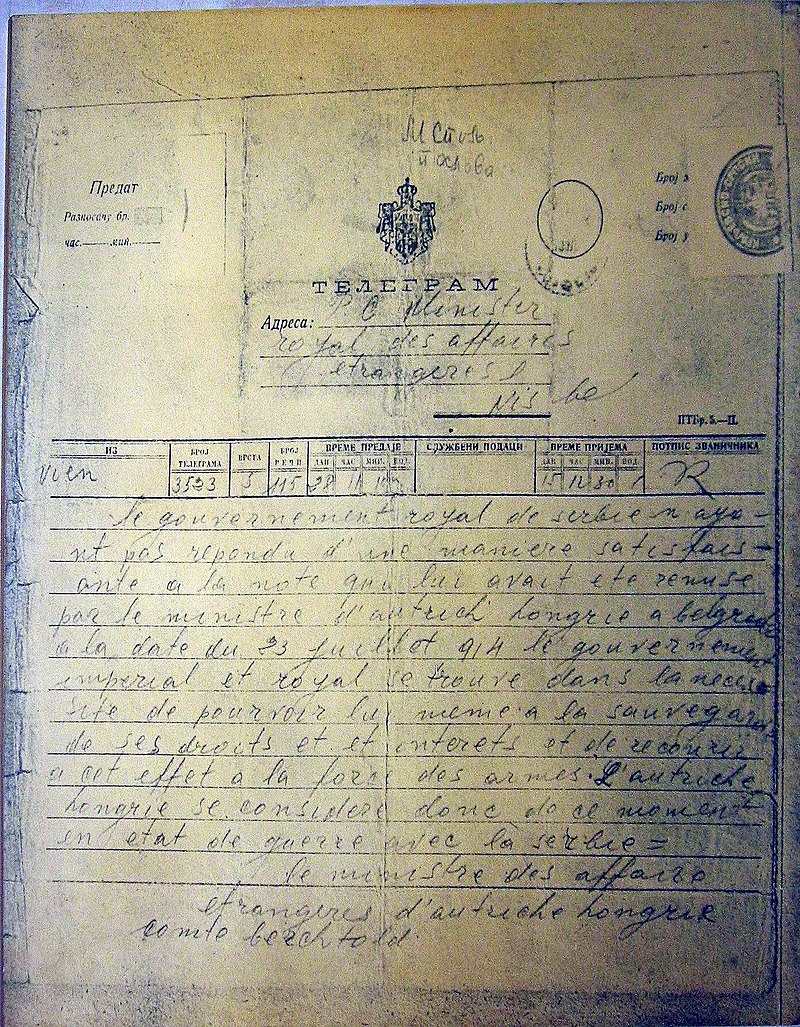
The Outbreak of World War I: Rise of European tensions, triggered by Balkan conflicts and alliances.
Germany
Political
Global Trade
5 min read
Updated By: History Editorial Network (HEN)
Published:
Updated:
Tensions in Europe had been mounting for decades due to rival alliances, military expansions, and nationalistic fervor among various empires and nations. One flashpoint was the Balkans, a region fraught with ethnic conflicts and territorial disputes. An assassination in Sarajevo, carried out by a Bosnian Serb nationalist, killed Archduke Franz Ferdinand of Austria, heir to the Austro-Hungarian throne. This act set off a series of diplomatic and military maneuvers among the European powers.
Following the assassination, Austria-Hungary, with backing from Germany, issued an ultimatum to Serbia, which contained numerous demands. Serbia's response, while conciliatory, did not meet all the demands. Consequently, Austria-Hungary declared hostilities on Serbia, setting off a chain of reactions.
Russia, bound by a treaty to Serbia, began mobilizing its forces. Germany, allied with Austria-Hungary, saw this mobilization as a threat and declared hostilities on Russia. France, allied with Russia, then found itself in a state of conflict with Germany and Austria-Hungary. Germany's implementation of the Schlieffen Plan, which involved invading neutral Belgium to quickly defeat France, brought the United Kingdom into the conflict due to its treaty obligations to protect Belgium.
The immediate impact was the rapid mobilization of armies across Europe, leading to large-scale battles. Within weeks, the conflict had drawn in all the major European powers, as well as numerous smaller states from different parts of the world, creating a truly global conflict. Human lives, resources, and economies were entangled in what would become one of the deadliest and most widespread wars in human history.
By the end of the war, millions had perished, empires had dissolved, and the map of Europe had been redrawn. The war's consequences set the stage for major political changes, including revolutions and the formation of new nations, thus reshaping global interaction in the 20th century.
#WWIStart #CausesOfWWI #AustriaHungary #SerbiaConflict #EuropeanHistory #GlobalWar #MoofLife
Primary Reference
World War One: 10 interpretations of who started WW1 - BBC News
Explore the Life Moments of
 AI Twin