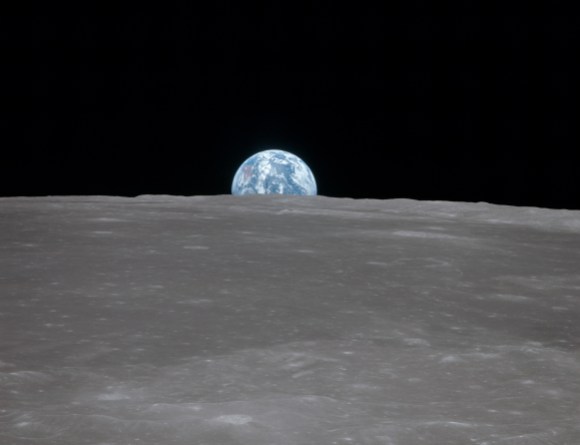
Copy of Wikipedia Sent to the Moon
Moon, Mare Serenitatis (Sea of Serenity)
Space Exploration
Technology
6 min read
Updated By: History Editorial Network (HEN)
Published:
Updated:
In April 2019, a complete copy of the English Wikipedia was transported to the Moon aboard Israel’s Beresheet lunar lander as part of the Arch Lunar Library project created by the Arch Mission Foundation. The mission aimed to preserve a long-term backup of human knowledge beyond Earth by placing durable information archives in space. Although the spacecraft ultimately crashed during its lunar landing attempt, experts involved with the archive later stated that the data storage system likely survived the impact.
The Beresheet spacecraft was developed by the Israeli non-profit organization SpaceIL together with Israel Aerospace Industries. After launching aboard a SpaceX Falcon 9 rocket on 22/02/2019, the spacecraft entered lunar orbit and attempted a landing in the Moon’s Mare Serenitatis, also known as the Sea of Serenity. During the descent on 11/04/2019, the lander experienced a main engine failure that interrupted its braking sequence. Mission controllers lost contact shortly before impact, and the spacecraft struck the lunar surface at an estimated speed of roughly 300 miles per hour, or about 480 kilometers per hour.
The onboard Lunar Library archive was designed as a highly durable preservation system. According to the Arch Mission Foundation, the library stored approximately 30 million pages of information totaling around 100 gigabytes of compressed data. Its contents included the entire English Wikipedia, thousands of books, language dictionaries covering about 5,000 languages, and various scientific and cultural datasets. The archive was micro-etched onto 25 thin nickel discs, each approximately 40 microns thick, layered together into a compact structure engineered for extreme durability.
One distinctive feature of the archive was its low-tech readability. The upper layers of the nickel discs contained microscopic images and text that could be viewed using a standard optical microscope, eliminating the need for electronic decoding systems for part of the archive. Additional digital information was encoded in microscopic form beneath those layers. The nickel-based design was intended to withstand radiation, vacuum exposure, temperature extremes, and long-term storage conditions in space for potentially billions of years.
Following the crash, members of the Arch Mission Foundation stated that the Lunar Library likely remained intact due to the resilience of the nickel discs and the compact structure of the archive package. Although the Beresheet spacecraft itself was destroyed, the library is believed to still rest on the lunar surface today.
Why This Moment Matters :
The Beresheet Lunar Library project represented one of the first large-scale attempts to preserve human knowledge permanently beyond Earth. By including Wikipedia alongside books, language archives, and scientific records, the mission reflected growing interest in long-term digital preservation and the idea of creating distributed backups of civilization in space.
#mooflife
#MomentOfLife
#Wikipedia
#Moon
#ArchLunarLibrary
#SpaceExploration
#CulturalPreservation

Explore the Life Moments of
 AI Twin