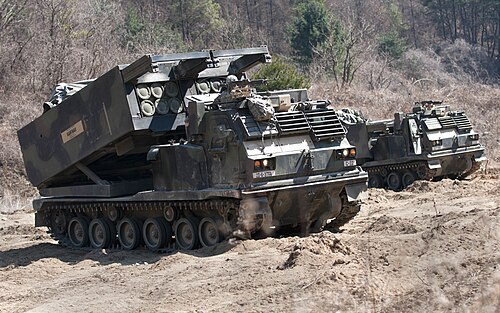
MLRS (Multiple Launch Rocket System) Enters U.S. Army Service
3 min read
Updated By: History Editorial Network (HEN)
Published:
The Multiple Launch Rocket System (MLRS) officially entered U.S. Army service in the early 1980s, marking a significant evolution in artillery warfare. Developed to provide highly mobile, high-volume firepower, the MLRS was designed to saturate target areas with a rapid barrage of rockets, enhancing the Army's ability to suppress, neutralize, or destroy enemy forces over a wide area. The system was first fielded in 1983 with the M270 launcher, mounted on a tracked armored chassis. Capable of firing 12 rockets in under a minute, the MLRS offered a powerful alternative to traditional tube artillery and quickly became a core component of NATO’s conventional deterrence during the Cold War.
The introduction of the MLRS revolutionized battlefield tactics by combining mobility, firepower, and accuracy through its use of GPS-guided rockets and, later, Army Tactical Missile System (ATACMS) missiles. It allowed commanders to deliver devastating strikes from long distances and then rapidly relocate to avoid counter-battery fire. The MLRS proved its effectiveness in major conflicts such as the Gulf War, Iraq War, and more recently in support of NATO operations. Its ongoing modernization—such as integration with precision strike missiles—ensures that the system remains a critical part of U.S. and allied artillery capabilities in modern and future warfare.
\#MomentsOfLife #MoofLife\_Moment #MoofLife #MLRS #MilitaryTechnology #Artillery #USArmy #ModernWarfare

Explore the Life Moments of
 AI Twin