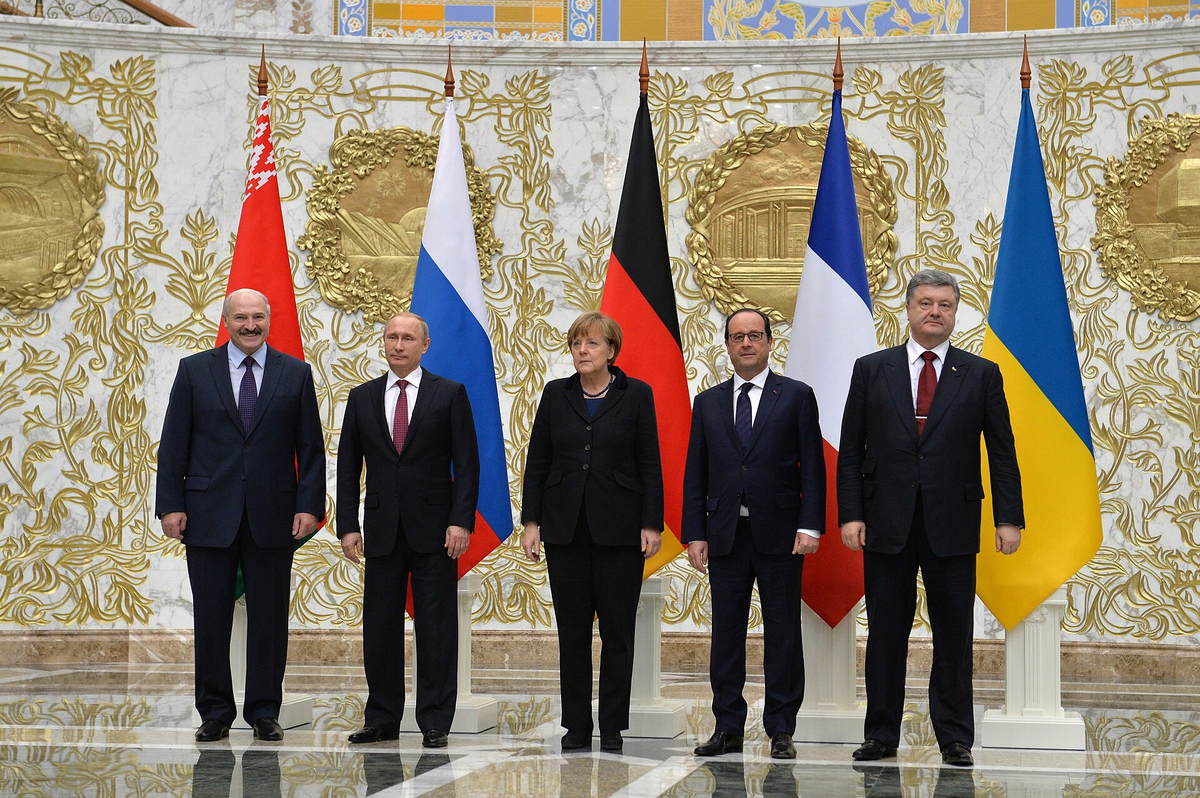
Peace agreements signed to resolve conflict in Eastern Europe.
Ukraine
Political
Global Conflict
4 min read
Updated By: History Editorial Network (HEN)
Published:
The Minsk Agreements were negotiated to address the ongoing conflict in Eastern Ukraine between Ukrainian forces and separatist groups. Multiple negotiations, mediated by the Organization for Security and Co-operation in Europe (OSCE) and involving leaders from Ukraine, Russia, Germany, and France, culminated in this effort to reduce hostilities.
The agreements aimed to implement an immediate ceasefire between the conflicting parties. They included the withdrawal of heavy weaponry, the release of hostages and unlawfully detained individuals, and efforts towards political solutions, such as local elections in the separatist-controlled regions. Troop disengagement and broader Ukrainian constitutional reforms that would decentralize power were also part of the accords.
Despite these arrangements, the implementation of the Minsk Agreements faced significant challenges. Violations of the ceasefire were frequent, and there was a persistent lack of adherence to various terms from both sides. Consequently, the anticipated peace and stability were only partially realized, prolonging the humanitarian impact on civilians in the region.
Statistics show that thousands of lives were lost due to the conflict, with tens of thousands injured and over a million displaced. The agreements, while a step towards peace, underscored the complexities of achieving a durable resolution in conflict zones where geopolitical tensions are high.
The Minsk Agreements remain a focal point in discussions about conflict resolution and international diplomacy in the region, reflecting ongoing efforts for peace despite myriad challenges. Their implementation continues to be monitored and revisited by international bodies and state actors.
#MoofLife #MinskAgreements #UkraineConflict #Diplomacy #PeaceEfforts #InternationalRelations
Primary Reference
Unanimously Adopting Resolution 2202 (2015), Security Council ...

Explore the Life Moments of
 AI Twin