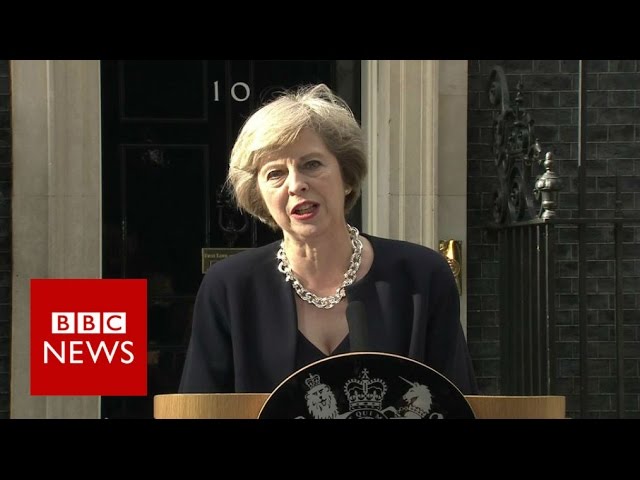
Theresa May becomes the Prime Minister
Appointment of the Prime Minister
10 min read
Updated By: History Editorial Network (HEN)
Published:
On July 13, 2016, Theresa May became the Prime Minister of the United Kingdom, succeeding David Cameron. Her rise to the premiership occurred during one of the most tumultuous periods in recent British political history, marked by the aftermath of the Brexit referendum.
Theresa May, born on October 1, 1956, in Eastbourne, East Sussex, was educated at St Hugh's College, Oxford, where she studied geography. She embarked on a career in banking before entering politics. May was elected as the Member of Parliament (MP) for Maidenhead in 1997. Over the years, she established herself as a capable and dedicated public servant, holding various roles, including Chairman of the Conservative Party and Home Secretary.
May's tenure as Home Secretary from 2010 to 2016 under David Cameron was notable for her strong stance on immigration and her efforts to reform the police force. Her reputation for diligence and competence earned her respect within the Conservative Party and positioned her as a serious contender for party leadership.
The Brexit referendum on June 23, 2016, in which 52% of voters opted to leave the European Union, triggered David Cameron's resignation, as he had campaigned for Remain. The ensuing leadership contest within the Conservative Party saw several prominent figures, including Boris Johnson and Michael Gove, fall by the wayside. Ultimately, Theresa May emerged as the consensus candidate, winning the support of a broad cross-section of the party.
On July 11, 2016, after her last remaining rival, Andrea Leadsom, withdrew from the race, May was confirmed as the new leader of the Conservative Party. Two days later, she was invited by Queen Elizabeth II to form a government, officially becoming the UK's second female Prime Minister, following in the footsteps of Margaret Thatcher.
In her first speech outside 10 Downing Street, May set the tone for her premiership by emphasizing unity, social justice, and her commitment to making Britain work "for everyone, not just the privileged few." She pledged to address the deep divisions exposed by the Brexit vote and to negotiate a Brexit deal that would honor the referendum result while safeguarding the nation's interests.
One of May's first significant actions as Prime Minister was to establish the Department for Exiting the European Union, appointing David Davis as Secretary of State for Brexit. She also made key appointments, including Boris Johnson as Foreign Secretary, to bring together a Cabinet that could manage the complex and contentious process of leaving the EU.
The defining issue of May's premiership was undoubtedly Brexit. She outlined her approach in a landmark speech at Lancaster House in January 2017, where she laid out her 12-point plan for Brexit, including leaving the single market and the customs union while seeking a comprehensive free trade agreement with the EU. Her mantra, "Brexit means Brexit," aimed to reassure Leave voters that their decision would be implemented fully.
In an effort to strengthen her mandate, May called a snap general election in April 2017, hoping to increase her parliamentary majority and secure a stronger position in Brexit negotiations. However, the election, held in June 2017, resulted in a hung parliament. The Conservatives lost their majority and had to rely on a confidence-and-supply agreement with the Democratic Unionist Party (DUP) to stay in power. This outcome weakened May's position both domestically and in negotiations with the EU.
The subsequent Brexit negotiations were fraught with difficulties. May's proposed withdrawal agreement faced fierce opposition from various factions within Parliament. Key points of contention included the Irish backstop, designed to prevent a hard border between Northern Ireland and the Republic of Ireland, which many MPs feared could trap the UK in a permanent customs union with the EU.
May's withdrawal agreement was rejected by Parliament three times, leading to significant political turmoil. Despite her efforts to find a compromise and her appeals for unity, she was unable to secure the necessary support for her deal. The repeated defeats led to increasing pressure from within her party and the wider political spectrum.
On May 24, 2019, Theresa May announced her resignation as leader of the Conservative Party, effective June 7, 2019, acknowledging that she had been unable to deliver Brexit. She remained as Prime Minister until July 24, 2019, when Boris Johnson succeeded her following a leadership contest within the Conservative Party.
Theresa May's premiership was marked by her determination to navigate the UK through the unprecedented challenge of Brexit, her commitment to public service, and her resilience in the face of immense political pressures. Her legacy is closely tied to the Brexit process, highlighting the complexities and divisions that have characterized this defining period in British politics.
#MomentsOfLife #MoofLife_Moment #MoofLife #TheresaMay
Primary Reference
Statement from the new Prime Minister Theresa May - GOV.UK
Explore the Life Moments of
 AI Twin