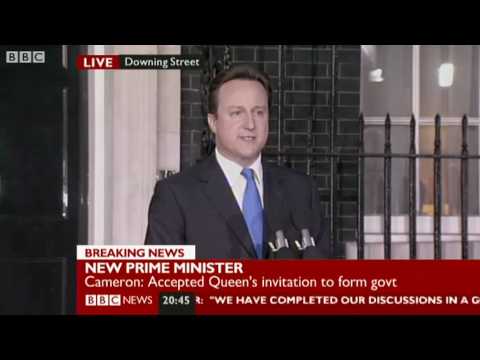
David Cameron becomes the Prime Minister
Appointment of the Prime Minister
9 min read
Updated By: History Editorial Network (HEN)
Published:
David Cameron became the Prime Minister of the United Kingdom on May 11, 2010, marking the beginning of a new era in British politics. His ascent to the premiership followed a closely contested general election and ended 13 years of Labour Party governance under Tony Blair and Gordon Brown.
David Cameron was born on October 9, 1966, in London. He was educated at Eton College and later at Brasenose College, Oxford, where he studied Philosophy, Politics, and Economics (PPE). His early career included a stint as a special adviser and in public relations before he entered Parliament as the MP for Witney in 2001.
Cameron's rise within the Conservative Party was rapid. By 2005, he was elected as the party leader, succeeding Michael Howard. At 39, Cameron was the youngest leader of the Conservative Party since William Pitt the Younger. His leadership style was characterized by a modernizing agenda aimed at broadening the party's appeal, focusing on issues such as climate change, social justice, and public services, in an effort to shed the "nasty party" image that had plagued the Conservatives in the past.
The 2010 general election resulted in a hung parliament, with no single party achieving a majority. The Conservatives won the most seats but fell short of an outright majority, leading to five days of negotiations. Ultimately, Cameron formed a coalition government with the Liberal Democrats, led by Nick Clegg, who became Deputy Prime Minister. This coalition was the first of its kind in the UK since World War II.
As Prime Minister, Cameron's government prioritized economic austerity, aiming to reduce the national deficit following the 2008 financial crisis. Chancellor of the Exchequer George Osborne introduced significant spending cuts and tax reforms as part of this austerity agenda. These measures were controversial and sparked widespread public debate and protest.
Cameron's tenure was also marked by several significant policy achievements and reforms. His government introduced the Health and Social Care Act, which reformed the NHS, and the Welfare Reform Act, which aimed to overhaul the benefits system. Education reforms included the expansion of academies and free schools. Additionally, the government passed the Marriage (Same Sex Couples) Act 2013, legalizing same-sex marriage in England and Wales, a landmark move for LGBT rights in the UK.
Foreign policy during Cameron's premiership included active involvement in international affairs, such as military intervention in Libya in 2011, and efforts to address the Syrian civil war and the rise of ISIS. Cameron also sought to renegotiate the UK's relationship with the European Union, promising and eventually delivering a referendum on EU membership.
The question of EU membership defined the later years of Cameron's premiership. In response to growing Euroscepticism within his party and the rise of the UK Independence Party (UKIP), Cameron promised an in-out referendum on EU membership if the Conservatives won the 2015 general election. The Conservatives achieved a surprising majority in that election, largely credited to Cameron's leadership and campaign strategy.
On June 23, 2016, the EU referendum was held, and 51.9% of voters chose to leave the European Union. Cameron had campaigned for the UK to remain in the EU and had warned of the economic and political risks of Brexit. The result was a significant political and personal defeat for him. The following day, Cameron announced his resignation, stating that fresh leadership was needed to guide the country through the Brexit process. He officially stepped down on July 13, 2016, and was succeeded by Theresa May.
David Cameron's time as Prime Minister was characterized by significant economic, social, and political changes. His efforts to modernize the Conservative Party, implement austerity measures, and navigate the complexities of coalition government were significant aspects of his legacy. However, his decision to hold the EU referendum and its outcome ultimately defined his premiership, leaving a lasting impact on the UK's political landscape.
#MomentsOfLife #MoofLife_Moment #MoofLife #DavidCameron #UKPolitics #Brexit #PoliticalLeadership #ConservativeParty #BritishPrimeMinister
Primary Reference
David Cameron - Wikipedia
Explore the Life Moments of
 AI Twin